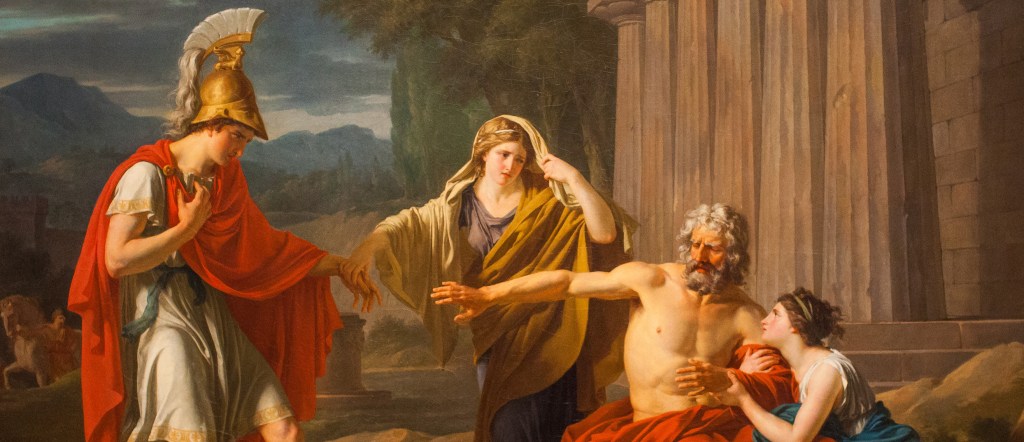
Sophocles’ tragedy, Oedipus Rex, is familiar, if only as the inspiration for Freud’s infamous ‘Oedipus Complex’. The play is generally regarded as one of the greatest works of literature ever produced, with no less a figure than Aristotle claiming that Oedipus is the ideal tragic hero.
Of course, it was also Aristotle who defined what exactly a tragic hero is: a man of noble birth and high status; not perfect, thus relatable; but possessing hamartia, or a tragic flaw, which ultimately brings about his downfall. It is, however, hard to see, just why Oedipus is seen as the ideal of this kind of character. Oedipus, after all, is fated to do precisely what he does so it would make no difference whether he has a tragic flaw or not – the Delphic Oracle has spoken!
That said, this oracle is unusually specific. The Delphic Oracle was notorious for leaving recipients to work out for themselves what was the meaning of the Oracle’s insight. Croesus was famously told that, if he went to war against the Persians, a great nation would fall. Croesus did indeed go to war with the Persians and the great nation that fell was his own! It was far from clear, usually, just what the oracle was saying. Another example: when Aegeus asked how he was to have a son, the oracle replied, “Do not open the foot of the wineskin until you return home.” Little wonder Aegeus had to go seeking advice on what this oracle might mean.
So, when Oedipus receives the prophecy that he will kill his father and marry his mother he could, at least, be grateful that the oracle, for once, avoided ambiguity. It was clear to Oedipus exactly what he should do to avoid his fate – runaway from home!
Though we commonly talk about Ancient Greece, no such place really existed. Rather, that geographic area to which we refer was made up of separate city states. So, when Oedipus left Corinth to go to Thebes it was a very definite move away from home. By making such a move, Oedipus was placing himself physically out of reach of his parents. Thus the oracle had no hope of coming true.
Unfortunately, as is often the way in Greek myths and legends, it is this very act of attempting to avoid his fate which actually leads to its fruition. Unbeknownst to Oedipus, King Polybus and Queen Merope of Corinth are not, in fact, his parents. They, of course, are the King and Queen of Thebes – Laius and Jocasta. Thebes – the hope of escape – is the destination to which his fate is driving him.
Fate, it seems, is not something to be escaped!
It is on his way to Thebes that Oedipus encounters his father. Oedipus is walking towards Thebes; Laius is walking in the opposite direction. One of these two parties is going to have to get off the road to allow the other to pass. Logically, this should be Oedipus, as he is a single person, as opposed to Laius and his entourage. But things are never as simple as that!
Laius is a king and so not about to step aside for some lone traveller. Oedipus, however, is a prince of Corinth, so, by the same token, he doesn’t feel compelled to step aside either. Battle ensues, Oedipus emerges victorious, first part of the prophecy is fulfilled!
What is important here is that Oedipus is motivated by his desire to avoid his fate and, in no way, by some imagined hamartia, or tragic flaw. But, just as importantly, both parties are also urged on by social expectations. As royal personages, neither Laius nor Oedipus could cede the road to the other without huge amounts of humiliation. No Greek of noble birth could countenance such a thing. Both, then, are as much fated by social convention as they are by whatever the Greeks actually thought fate was.
It is impossible to know what Aristotle meant when he esteemed Oedipus the ideal tragic hero. Whatever his reason, it seems clear that one reason why this character has proved so enduring, so influential and so intriguing is because of the different levels his story works on.
It is, in fact, the father, Laius, who commits the crime which brings down the curse of the gods upon his family.
As briefly as possible, the story goes like this: Laius’ father was the king of Thebes. He was overthrown but Laius was smuggled out of the city and given refuge by Pelops, king of Pisa. Whatever gratitude Laius may have had for Pelops it didn’t prevent him raping the king’s son, Chrysippus. This is the action that brought the curse. Not because homosexuality was condemned in Ancient Greece – far from it! Lauis’ crime was against the code of Xenia – or hospitality. To incur the wrath of the gods was to bring doom upon the whole family down the generations – just ask the House of Atreus!
Ultimately, then, Oedipus’ fatal flaw (if, indeed, it can be so called) was to be born to King Laius in a culture that valued the hero, whether his actions be for good or ill. In this sense, then, it is inaccurate for Sophocles to refer to Laius’ killing as murder, as he does in Oedipus Rex. To state the obvious, murder is the unlawful taking of another’s life. But, as we saw earlier, the meeting between the two royal personages at the crossroads was compelled as much by cultural expectations as it was by any curse on the House of Laius.
An important factor to consider is the Ancient Greek concept of kleos. Heroes like Achilles were fully aware of the importance of establishing their name and to have it sung for always in poetry. Whether Oedipus, at this stage of his career, also fostered such hopes is debatable. Certainly, by the time we get to the events of Oedipus Rex, he is very conscious of his fame and greatness but, at this moment of confrontation with his father, we cannot be so sure. Yet, as a lone individual, he takes on a whole entourage of opponents and wins! Surely, even to just consider such an action, he must have had some sense of kleos? Only a hero could have taken on such odds and triumphed.
It is unimportant whether the events of the story, as they have come down to us, are fantastic – surely no single man could have battled such numbers successfully? The important point is that this event occurs in the story of Oedipus because it fits in with the nature of the Greek hero. Even accepting the curse of the gods, Oedipus is a tragic hero because he is entirely subject to Greek convention, lacking, therefore, the freedom to be his own man. Oedipus is tragic because he was created to be tragic. The oracle, then, can be seen, not so much as the gods meddling in Oedipus’ life, but rather as the culture demanding he be what it wishes its heroes to be.
Oedipus the double-fated hero – fated by the gods to kill his father and marry his mother; fated by his culture to live up to the ideals of the hero.


Leave a Reply