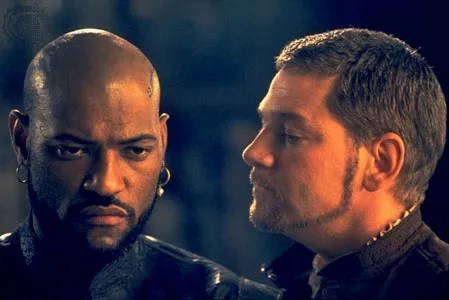
One of the more puzzling aspects of Shakespeare’s Othello is precisely why does Iago do all that he does; deliberately manipulating others to bring about the murder of the innocent Desdemona and the suicide of the mercenary Moor? That there appears to be no satisfactory answer to this puzzle is what makes it so entertaining.
At the very opening of the play we find Roderigo and Iago on their way to inform Brabantio of the relationship between his daughter and Othello. This act, while treacherous, is, at least, understandable. A black man, a mercenary, a foreigner, a mere soldier deflowering the pure daughter of so respectable a man as Brabantio would be nothing less, could be nothing less, than scandalous, horrifying and down-right threatening to the white man’s ego. Brabantio had to be told and Roderigo and Iago are more than willing to go out in the night to ensure the message is received and understood. The two men, however, each have their own ulterior motives for their actions. Roderigo has very definite intentions towards Desdemona himself. It would be to his benefit, as he sees it, if Brabantio could somehow undo the union of Moor and Maid.
Iago, always fond of making clear his intentions and feelings, tells us outright that he thinks Michael Cassio unsuited to the promotion handed him by Othello and that, instead, it should have been him chosen as the Moor’s new officer. Whether or not this sleight is enough in itself to motivate Iago’s actions throughout the rest of the play, it is certainly the catalyst which lights the spark. Iago has a high opinion of himself and is therefore unable to countenance any reason for what he sees as a betrayal. To be fair, if what Iago has to say about Cassio’s lack of experience on the battlefield is true then there is some justification for his hurt pride. His response might be thought a tad excessive, however.
Truth is, though, whatever reason(s) one provides to explain Iago’s behaviour, it remains beyond the pale.
Two common thoughts are that Othello has slept with Emilia, Iago’s wife – an idea that certainly carries some motivating force – and that Iago is simply racist towards the black Moor, Othello.
Granted that it is not unknown for a cuckolded man to resort to violence upon discovering that his wife has been unfaithful. Such violent responses, however, are immediate and/or highly emotional; rarely if ever are they long, drawn-out, intricately planned masterworks of manipulation.
Likewise, there is a weakness with the racism argument. Racism, almost by definition is irrational and not the province of highly intelligent individuals. Witness the stupidity of the Ku Klux Klan, in Spike Lee’s excellent film BlacKkKlansman (2018), who allowed a black policeman to join the organisation – a black policeman who was then aided and abetted by a Jewish colleague. Aggressive racists prefer the anonymity and the diffusion of responsibility of the group. Hence, the Klan.
If not one of these proffered reasons is enough in itself to explain Iago’s manipulative majesty, could we not argue that it is all of them together which ignite his desire for vengeance? Certainly, a racist who believes a black man has slept with his white wife and who feels slighted professionally by that same black man is very likely to seek some form of satisfaction? Quite possibly. But this would make Iago’s actions the result of cumulative influences – the pressure has been building till it has reached this point at which it needs to be released, expressed in some form of active malignity.
And, again, we have to acknowledge that the form of Iago’s vengeance does not fit this scenario. Such a man is highly unlikely to find his pride requited by such surreptitious means as Iago employs in order to manoeuvre his pieces into positions where the outcome is precisely as he dictates. Such a man would want to feel he was taking control back from those who had robbed him of it; and to do this, he would need to be the one who made them pay. Such a man would demand satisfaction and would have no need for a second to step into his place.
There is another huge weakness with this view of Iago’s actions. A man does not suddenly become a maestro of marionettes overnight. Cuckoldry, racism, promotion – these are Iago’s justifications; not his motivations. Iago does what he does because it is who he is, who he has always been. In an age when origin stories are done over and over and over, it might be frustrating to some not having an origin for Iago. Shakespeare simply presents the audience with Iago’s actions, blithely ignoring any need to explain them. And, four hundred years later, we are still asking the questions. Makes one wonder if Shakespeare knew what he was about?
In the Spring, 2014 issue of The Hudson Review, Richard Hornby offers an interesting reading of Iago. In this article, Hornby speculates that Iago is a throwback to a bygone age of Morality Plays, in which it is useless to “delve into a vice character’s past life in search of motivation … because he has no past; he just is what he is, always was, and always will be.” Hornby’s argument is fascinating and certainly provides enough explanatory power for Iago to make it worth serious consideration. Shakespeare, according to Hornby, could well have witnessed these Morality plays in his youth, before they were banned out of suspicion of being “loaded with traditional Catholic doctrine”. Of course, there has long been speculation regarding Shakespeare’s possible Catholicity but, as with much else with the Bard, there is no definitive evidence so it falls into the burgeoning branch of Bardolatry: What is there left to say about Shakespeare?
As fascinating as Hornby’s argument is, I find it not entirely satisfactory. It just doesn’t sit well to think that a major Shakespearean character is little more than a cypher for hidden Catholic devotion. Think of the naked ambition of Macbeth, the philosophical procrastination of Hamlet, the juvenile immediacy of Romeo – all great Shakespearean characters; all fully human.
There is a relatively straightforward way to understand Iago – the man is a psychopath! Now, obviously, this is not a term with which Shakespeare would have been familiar – largely due to it having been coined only as recently as 1888, by a German psychiatrist called J.L.A. Koch. We should always be wary of anachronistically placing words and ideas in the minds of long-dead writers and it is not as if Shakespeare was ever at a loss for words, requiring assistance from the impoverished vocabularies of those who continue to find reason to explain him.
But, if Shakespeare did, as Harold Bloom advocates, invent the human – and we have seen how incisive were his observations of human character with Macbeth, Hamlet and Romeo – then it is likely that he was very much aware of a type of individual who exhibited a number of characteristics that could be employed in a character of his own. Without explanation, he paints the picture of a man who possesses a ‘grandiose sense of self-worth’, who is cunning and manipulative, lacking remorse or guilt, finally failing to take responsibility for his actions by claiming “From this time forth, I will never speak a word.” There are other elements of the psychopathic personality (see Hare’s Psychopathy Checklist) and some can, within reason, be applied to Iago. Some, like ‘juvenile delinquency’ cannot just because we know nothing of the character’s background and origins.
The advantage of seeing Iago in terms of psychopathy is that it would explain how he is so easily able to manipulate so many others. To claim any of the other popular reasons would not be sufficient to explain this quality of Iago’s personality. If, indeed, he can be seen as a psychopath, then the magisterial manipulation he demonstrates throughout the play is readily explained – Iago seeks the form of revenge that he does because it is who he is!


Leave a Reply