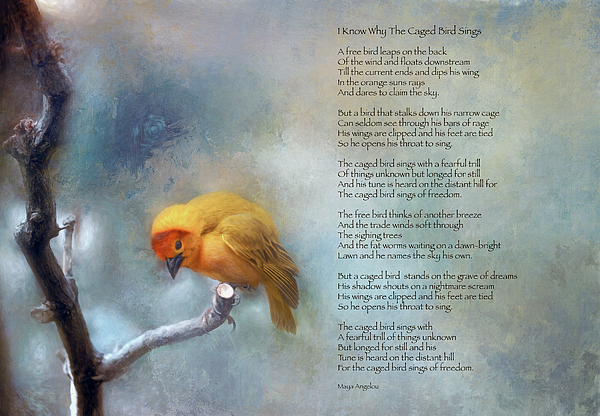
Maya Angelou‘s poem, Caged Bird, is concerned with the lack of freedom. This theme is established through the comparison of the two birds – one free to fly where it will, the other with clipped wing, confined to a cage. This is a blatant image and leaves little to the imagination of the reader.
Of course, poetry is notorious for being difficult to understand, so is it not the case that Angelou’s poem is just too simple to be considered a great poem?
What we need always to be aware of is the writer’s choices when constructing any literary piece. It may well be that we can never really know the intentions of the writer – we have never met them, are unlikely to meet them and, anyway, many of them are dead and beyond knowing. Yet, there is much that we can deduce and infer from the words we have before us. And, even more, there is nothing to prevent us from constructing our own understanding of the written work – so long as our readings remain within the possibility of the text.
A great piece of literature, then, is one that offers us both an insight into what might have been intended and a degree of freedom to indulge our own creative reading.
That said, there is more than enough evidence to support the view that this particular poem of Angelou’s is, indeed, a great poem.
Let’s take one example and look at the juxtaposition of language which contributes to the comparison between the two birds.
The free bird is said to ‘leap’ on the ‘back of the wind’ and float wherever the current may take him. That this bird is able to leap implies there is nothing to limit his energies, no fear of hitting a boundary. Quite the contrary, this bird hitches a lift off the wind and is free to go whichever direction the wind bloweth. What greater sense of freedom can there be?
In contrast, the caged bird ‘stalks’, a way of walking (not flying, notice) that is characterised as being measured and stiff, the very opposite of the free bird. This bird must always have control over his movements for his space is severely restricted. If this bird was to leap it would crash into the bars of its ‘narrow cage’.
We must, of course, notice the wings of these birds in these early stanzas. The free bird ‘dips his wings’ in flight, whereas the caged bird has ‘clipped’ wings, preventing flight. Surely, there can be no greater cruelty that to take from the bird the very essence of what it is to be ‘bird’? A bird without the power and freedom to fly is, to all intents and purposes, no longer a bird (apologies to emus, ostriches and penguins).
At this point in the poem, immediately after being told the caged bird’s wings have been clipped, we discover that its feet have also been tied. We are forced to consider, maybe for the first time, whether these birds are metaphorical, whether it is not merely the captivity of birds (however dreadful one might think this to be) with which the poem is concerned, but, more profoundly, whether it is not human captivity that lies at the heart of this poem. This is no great leap of intuition, knowing, as we do, Maya Angelou’s involvement with civil rights activism. Of course, the birds symbolise the dehumanising loss of freedom that is slavery.
So, the juxtaposition of language and this deeper layer of meaning contribute to the status of this poem. Though straightforward in many ways, it is also complex in both the structuring of language and meaning. This is even more the case when we consider whether we should simply accept that one bird is free while the other is captive.
An excellent analysis of this poem can be found on the Poetry Prof‘s website. When discussing Angelou’s use of enjambment, the Prof very cleverly identifies the free flowing of meaning from line-to-line without a break as indicative of the freedom experienced by one bird, while the capital letter and full-stop, at the beginning and end of each stanza, indicate the solid confines of captivity for the other. While I am ready to accept this interpretation of Angelou’s structuring of her stanzas, it does leave me wondering.
In a sense, the Prof’s explanation is only partial, for, while the use of enjambment might represent the unhindered flight of the free bird, still, the stanza begins and ends with a full-stop for both birds. And if enjambment creates a sense of freedom for one bird, what does its use represent for the caged bird?
Imagine reading along a line from left to right, reaching the line’s end and having to shift one’s gaze back to the left for the next line, and the next, and the next, and so on. While the Prof may well be right to suggest this “expresses the freedom he (the free bird) has to roam and fly”, it also very ably evokes the caged bird’s stalking up and down his narrow cage. The same technique, then, is used to represent both freedom and captivity. Should we ask, then, whether these birds serve only to highlight a contrast or might there, in fact, be something which connects them?
It is possible to see how Angelou has used one technique for two very different purposes – to represent both freedom and captivity. But, can we do the same for those capital letters and full-stops, which begin and end the stanzas for both birds? The Poetry Prof sees these as blocks or “walls, beyond which the caged bird may not pass”. Must we just ignore their use in the stanza for the free bird? Or, rather, do we recognise that, for all his dipping of wings and his floating “downstream / till the current ends”, the free bird might not be quite so free as he seems?
It is easy to see the dehumanising nature of the caged bird’s captivity. This poor creature has been confined and tied and, in all senses, deprived of all that would enable it to become all that it could be. Yet, in the midst of this horror, the caged bird sings, produces art and beauty.
It isn’t that the barbarity of slavery is to be condoned for out of it comes something positive and beautiful. This poem is most definitely against “man’s inhumanity to man”. Yet, just as Angelou employs enjambment for a dual purpose, so it may well be that the poem as a whole is not just about the horrors of captivity – it might also be about the horrors of freedom. It might not require a constant state of torment to produce great art, but all art is produced out of the conditions of the artist’s life, with all its freedoms and constraints. The boundaries of life serve to focus the creativity of the artist, make possible a response to the very conditions of existence. So, the caged bird sings, while the free bird produces nothing of worth.
It isn’t that the free bird is without constraint. His stanzas, too, begin with the block of a capital letter and end with the wall of the full-stop. But this bird is simply too full of himself to notice, an arrogance that leads him to “claim the sky” and name it his own. Not recognising the conditions of his own existence, the free bird has no response to make, thinking wilfully of nothing more than “another breeze”.
So, another layer of meaning is added to the poem. A poem which initially looks so straightforward, is, indeed, poetically complex. A great poem, indeed.


Leave a Reply