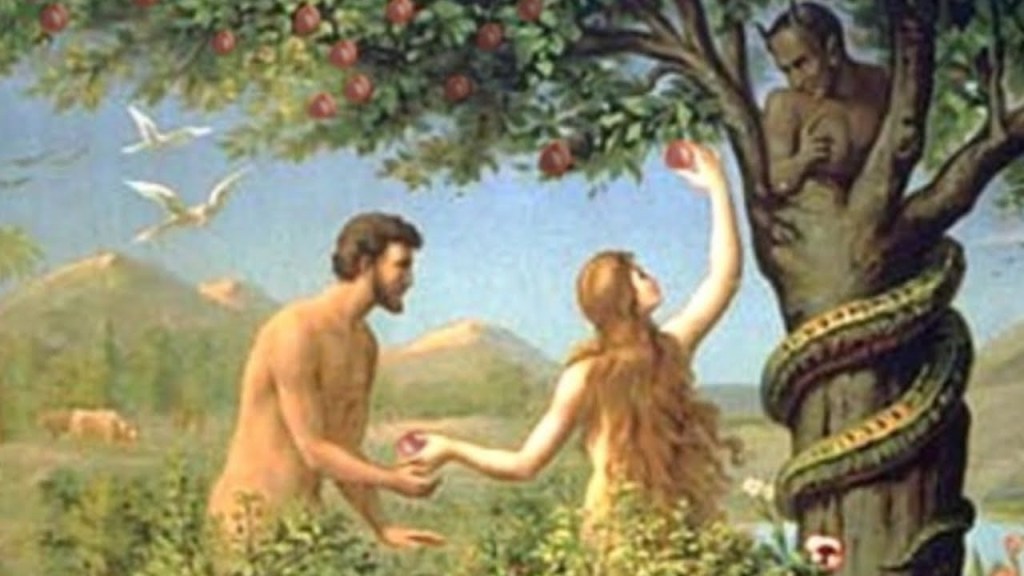
Anyone properly conversant with the Bible (which is no one who takes it literally) should recognise disobedience as inherent to human nature. Presumably, God created Adam as He wanted him to be; Eve likewise. God might have been angry that evening He went walking in the Garden and found Adam and Eve hiding their nakedness; there is no indication He was surprised.
Any religious colony which expects complete adherence to a strict code of life is blatantly ignorant of the kind of creature their God created them to be. Arthur Miller depicts Abigail Williams as disobedient almost from the first moment she appears on stage. Not because she leads the girls into the forest at night for some naughty dancing – though, of course, this would be punishable behaviour. As Mary Warren makes clear, dancing may be unacceptable but not the worst of crimes: “You’ll only be whipped for dancin’”. This is, in a sense, a misdemeanour, deserving only of a fine. This nighttime extracurricular activity is disobedient but poses no threat to the community. Miller has Abigail respond cogently to Reverend Parrish’ enquiries into the girls’ nocturnal shenanigans. It is when he raises the question of Abigail’s dismissal from the Proctor’s service that we see our first real glimpse of Abigail’s potential for disobedience on a scale that will bring down a community.
Attendance at church was a staple of Puritan life. As a community founded on their religious beliefs, this is hardly surprising. Non-attendance was another offence punishable by whipping. Yet, Goody Proctor, who is clearly a good person, whatever might be the problems between her and her husband, John, no longer attends church for, as it’s said, “she comes so rarely to the church this year for she will not sit so close to something soiled.” That something is Abigail.
In response to this accusation, Abigail, in modern parlance, loses it:
“She hates me, uncle, she must, for I would not be her slave. It’s a bitter woman, a lying, cold, sniveling woman, and I will not work for such a woman!”
The Crucible, Act I
Indeed, it may well be that Elizabeth Proctor is “cold” in the sense that she finds it difficult to express affection or sympathy – a failing which lies at the heart of her marital problems – but we learn, in that conversation she has with John Proctor in Act IV, that she is honest, anything but bitter and certainly not sniveling. This, then, is Abigail’s first false accusation.
That she is so willing to lie about Elizabeth Proctor throws her previously reasonable responses to Parris’ enquiries into doubt. She might technically be correct when she claims they “never conjured spirits”. But, it is a technicality because Tituba singing her “Barbados songs” in a forest, at night, over a cauldron of soup, while not ‘witchcraft’ for modern distinctions between cultures, could only ever be interpreted as such by Reverend Parris and the Salem Puritans. And Abigail would be fully aware of this.
Abigail, then, is cognisant of her disobedience; there is no way to excuse her behaviour. She is not an innocent, naive seventeen year old – as Mary Warren will be described. Rather, she is in absolute control of all that she says and all that she does. She is the tempter who leads others to sin and death; this is her purpose in the play. Abigail is the the satan in the Eden the Puritans would recreate.
We can compare Abigail Williams with Mary Warren in order to see this more clearly.
Mary, upon her first appearance, is said to be “seventeen, a subservient, naive, lonely girl”. Clearly, Mary doesn’t command the same attention as does Abigail. Indeed, when Abigail is dismissed from the service of the Proctors, it is Mary who takes her place. Mary, then, is seen as an acceptable young girl by Puritan standards. Unfortunately for her, she gets as caught up in events as the rest of Salem. Abigail has the strength to manipulate those events to her purpose; Mary does not.
Mary Warren is basically a good person too weak to stand against the forces at work in her community. That she does, if only temporarily, side with John Proctor, shows her as someone who would do the right thing if only she were strong enough. Mary Warren’s great sin is to be weak.
Of course, when we take the allegorical nature of the play into account, this is a grave weakness indeed. How many lives were ruined because, like Mary Warren, there were those who were not strong enough to stand against the false and malicious accusations of the House Un-American Activities Commission?
Within the play, however, Miller maybe reveals something of the magnitude of his humanity, for there is every reason to understand Mary’s predicament, even if we must ultimately condemn her for her weakness.
We are given no reason or cause to so understand Abigail Williams. She is nothing but the downfall of others – she is the Senator MaCarthy of the play, willing to sacrifice all and sundry for her own, personal aggrandisement. Abigail Williams is the serpent in the Garden – her only reason for being there being the usurpation of authority.
We should consider, however, whether this is such a bad thing? It is unlikely that Miller would want any kind of positive slant in regards to Abigail. We, however, no longer (if we ever did) live in 1950s America. There no longer is a HUAC. We do live in a culture that challenges perceptions of women (among others) and the social structures that created the subservient Mary Warrens, who lived in fear of stepping outside expectations. In such a climate, can we not reappraise Abigail Williams and see her as a feminist icon – a young woman willing to risk everything in order to bring into question the authority under which she lived?
The simple answer is no!
She uses the system which exists to her own ends. It is never her intention to undermine the very system that, perversely, gives her the power to achieve what she seeks. Perversely only because it is the self-same system which should have made her incapable of such machinations. Being human, Abigail is fully capable of disobedience. Because her Puritan community had no real conversation with their God, they had no way to defend themselves against such outright disobedience. When Abigail set herself on the course of making false accusations of witchcraft, her community, by its very nature, had no way to defend itself and, indeed, could do nothing but fuel her fire. Even worse, if we examine Parris’ questions to Abigail, it is her community which gave her the means of wreaking her vengeance.
More telling, however, are the victims of Abigail’s persecutions. To be seen as a feminist icon, she would have had to bring down her uncle, the Reverend Parris (among others). Not only does she not do this, he becomes her means of achieving her ends. She fully accepts her role as female in a male world and manipulates those clueless males to do what she would have them do. She does this within the system.
In the “Echoes Down the Corridor” at the end of the play, Miller informs us that legend has it that Abigail ended up as a prostitute in Boston. There is very possibly some way feminists could argue prostitution as a slap in the face of patriarchy; most of us wouldn’t get it though.
Whatever her end, Abigail Williams’ role within the play is purely destructive of the social order. She really is the satan that leads to death.
This post was inspired by a conversation with Mah Nilla Noory.


Leave a Reply