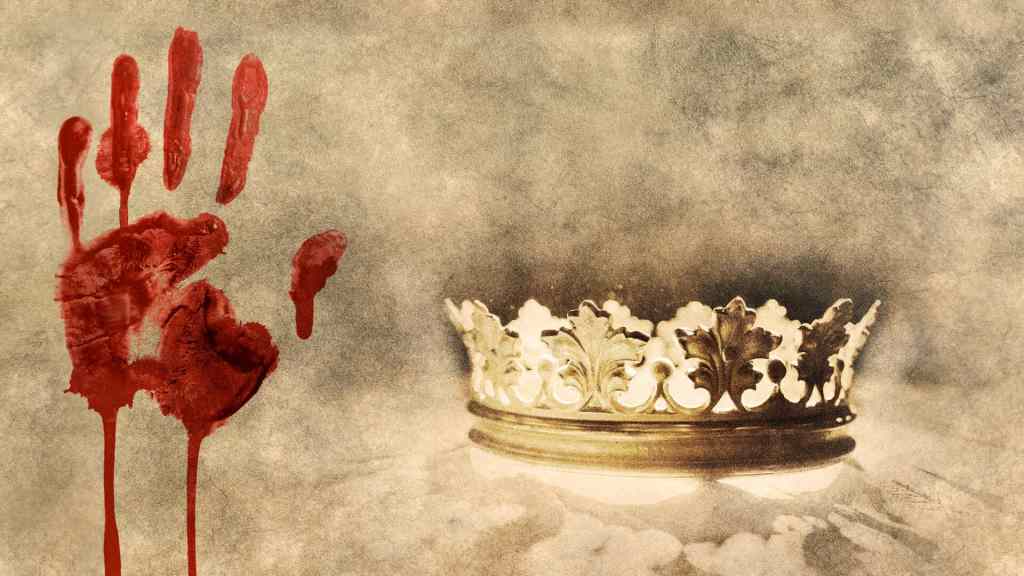
There is a reason why students of Shakespeare must perennially confront the questions of who is to blame for the deaths of Romeo and Juliet and whether Macbeth is free to act according to his own desires or is manipulated by his wife and/or the Witches. Simply put, Shakespeare gives us enough to raise the questions, but not enough to answer them – not in any definitive way. We are left, as the audience, to make up our own minds – only we can’t really do that because we only have enough for the question; yet it is the question that keeps us coming back to Shakespeare, in the foolish hope that, if only I keep looking, keep searching, keep asking, I’ll find that which no one else has so far found – the definitive meaning to a Shakespeare play.
In truth, there probably is no such thing to be found, so there’ll always be reason enough for another reading of Shakespeare. Like this one, for instance.
I want to ask the extent to which Macbeth is an autonomous individual, seeking to fulfil his ambition or is, rather, a puppet who dances to the whims of the Witches who, so clearly, pull his strings?
I will hoist my biases to the whipping post to make it clear where lies my purpose. I am, more than anything, a radical individualist, adamant in the belief that true freedom, health and beatitude are to be found only in the individual strong enough, brave enough and stupid enough to stand against the pressure to conform to the authority of others. However, I prefer to think myself not quite so stupid as to believe that an individual, however radical, is a being alone, dependent only upon self, unfettered from others. Quite the contrary, we are formed by our connections to others – or, deformed, as the case may be! The radical individual is the one who is able to distinguish between what is because it was given, what is because it must be, and what is because of what I choose will be!
Macbeth is a case in point. Clearly he is a man who is able to distinguish himself, a man defined by his situation, maybe, but one who is not limited thereby. Rightfully, he believes himself worthy of more. We question only his methods, not his goal.
But should we question the choices Macbeth makes? If we take the play metaphorically, can we not see Macbeth’s actions as, while extreme, nothing but a man taking charge of his dreams, achieving his goals, taking his destiny in his own hands?
This is a possible reading because we are well aware that the figure who appears in the play is not only not real – he is, after all, a character in a play – but he is not historical, either. This is an important point because there really was an actual figure from history – Mac Bethad mac Findláich – who did actually exist and who was made King after killing Duncan. That Shakespeare’s Macbeth bears so little resemblance to this historical figure gives us some room to conjecture his motives for making his Macbeth so very different. There is room to ask whether we should see the Shakespearean Macbeth as metaphor.
This leads us no closer to a definitive reading of the play because we still have no way of knowing what the metaphor is meant to signify – only what we read into it!
We are hindered by our lack of knowledge of Macbeth’s origins. Unlike modern superhero movies, which rehash origin stories ad nauseam, Shakespeare throws us, almost literally, into the middle of the battle. Macbeth just is who he is. And we accept this in a way that modern audiences seem unable to.
Not knowing where Macbeth comes from, we must just accept him. We have no choice. Yet, the man has a history. Events in his life, whether parental or societal, which influence the choices he makes and made him a man ready to face conflict head-on. Ideally, we would like to think he chose to be the warrior he clearly is, though this is unlikely. If, as Harold Bloom would have us believe, Shakespeare invented the human, then Macbeth is unlikely to have had much choice (if only because he doesn’t become “human” until his first appearance on stage). He might have failed to live up to expectations, of course, but, this too, would be beyond his control. Whichever way we look at it, the Macbeth we meet on the heath is the man we must understand.
This is the man who has reached that point in his life when he has become aware of himself. He is fully aware that the Witches have given him a choice – he can leave it to fate and see whether the Witches prophecy works out in the natural order of things, or he can ensure that they do by his own actions.
Even as metaphor, we can ask whether he chooses wisely. After all, the Witches prophesy that he will be King; it is Macbeth who chooses to act in order to ensure the prophecy’s fulfilment. If the Witches really are supernatural beings, then Macbeth would undoubtedly become King whether he acted or not. In deciding to murder Duncan, Macbeth ensures not the fulfilment of prophecy, but his own downfall. Therefore, we can say that Macbeth, even as metaphor, shows us that the individual must sometimes allow what will be to be when it is time – meddling with fate isn’t the action of a man taking charge of his destiny, rather is it the action of a fool!
In choosing the course of action he does, Macbeth is not acting as an individual. Firstly, the options only occur to Macbeth after hearing the prophecy of the Witches (not as the result of some deep self-awareness) and, secondly, he only decides to go through with the murder due to the manipulations of his wife. She it is, even more than Macbeth, who is impatient for the workings out of fate. Macbeth acts under the influence of others, so is a poor model of individuality. We can not look to Macbeth the metaphor as a man who gives us guidance on how to take charge of life.
Though, it would seem that he has acted as inspiration to the modern acquisitive culture. We would be far more rewarded by reading the play itself as a prophecy for how that individual, Shakespeare is supposedly responsible for creating, chooses to act when faced with the possibility of acquiring a dream. And the consequences thereof. In this sense, Shakespeare is as little understood as the Bible, which, among other things, tells stories for the same reason as does the Bard himself.
It is the extent that we don’t listen to our stories that we fall short of the radical individualist. For how can I know what was, what is, or what will be, if I fail to listen to the very source – the only source – of wisdom that can provide insight. We must look to Doctor Strange in Infinity War, who checks out all possible outcomes of the story and acts accordingly.
Thanos only acquires the Mind Stone from Vision after reversing time – a foreshadowing of the strategy the Avengers adopt in order to reverse the snap! As said, sometimes we have to allow what must happen in order to rise above and prove our worth by not succumbing to the fall-out. Macbeth fails this test. Thus proving those roller-coaster rides that are modern superhero movies have more to tell us about positive individuality than does Shakespeare, who chose to warn us of the dangers.
Please do not take this to mean that modern superhero movies exist in the same universe of greatness as does Shakespeare. But neither should one assume that any well-made and well-thought out movie, even if the characters wear their underpants outside their tights rather than their guns inside their waistbands, is a story not worthy of our attention. To assume that a well-told story has nothing to offer is to forget that individuality that Shakespeare enshrined.
Ultimately, the difference between Macbeth and Doctor Strange is that the former can’t wait for fate to take its course, while the latter is willing to risk his very existence on the faith he has in his fellow Avengers coming through – with one of them making the ultimate sacrifice.
Macbeth acts selfishly; Strange selflessly. Both are stories told upon a stage – one in Elizabethan theatre, the other on a Hollywood sound stage – sound and fury, signifying nothing? Only if you refuse to listen to the stories we tell ourselves. It can only be hoped that, once again, we’ll begin listening to what we’re saying!


Leave a Reply