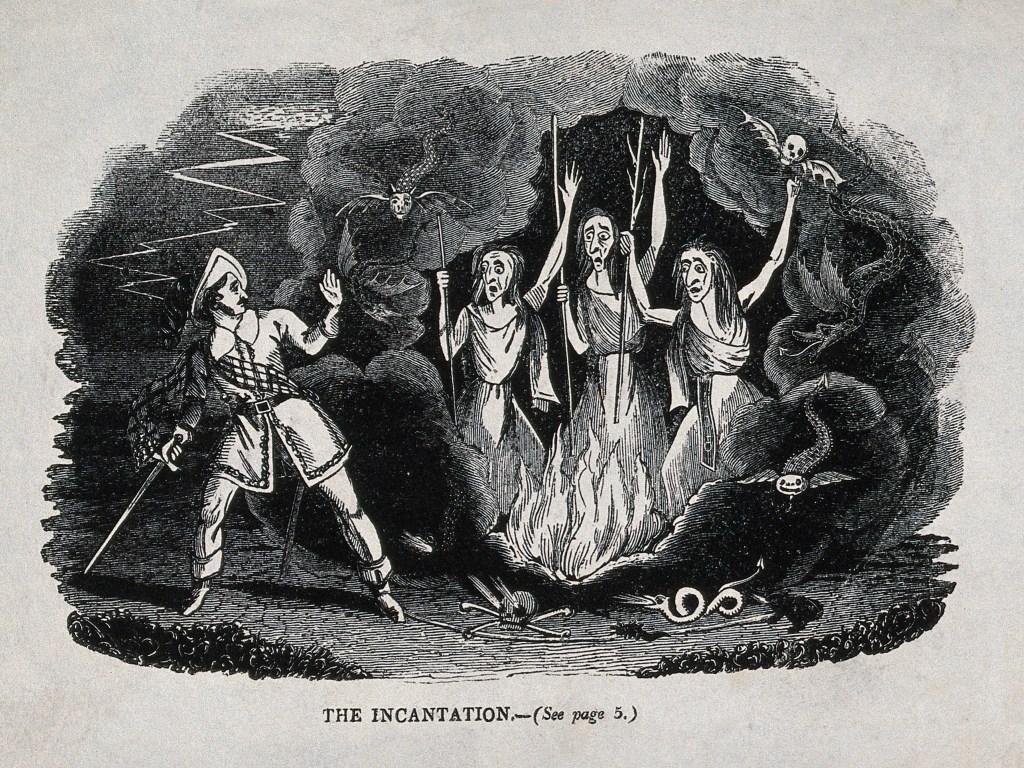
Macbeth, Shakespeare’s play about male ambition leading to death and destruction, opens with Witches. Whether they are there to please a King or to act as the stimulus to make a king, they are plainly evil. In this role they would be as familiar to Shakespeare’s audience as they remain to a modern one.
We can so easily point to any number of evil women who make appearances throughout Western culture – from Eve, who enticed her man to commit the first sin; through Medea, a mother who murdered her male children; to Shakespeare’s own Lady Macbeth, who could well embody the Enchantress who now adds a fourth figure to the more traditional triune archetype of Maid, Mother and Crone. That a particular horror accrues to the evil female is no more than the inherent sexism that has us convinced that women should not be capable of such crimes, due to their femaleness.
Shakespeare includes the Witches for various reasons, though, it seems, he wants to avoid simple stereotype by having them appear gender-ambiguous. As Banquo says upon first encountering the Witches: “…you should be women, / And yet your beards forbid me to interpret / That you are so.” Nor do these three specifically embody the triune archetype. All three have beards, if we take Banquo’s lack of distinction at face value. They are as indistinct as their motives: for we never do know why they place themselves in Macbeth’s path, why they single out this one man to trouble, why it is worth their time to stimulate his ambition.
That they are evil there is no doubt. For all we can say of them is that they do what they do, lighting the fuse which leads to the explosion of Macbeth’s ambition, for their own nefarious reasons. Just as they kill swine to pass the time and make the sailor, the husband of the woman who refused to share her chestnuts, for a whopping eighty-one weeks (“sennights nine times nine” or ‘sennights’ (seven nights or one week) 9×9=81). This punishment far outweighs the crime, thus evil. That they are evil is the least ambiguous aspect of the Witches. As witches, they can be nothing else but evil.
One certainly wouldn’t try, in any way, to rehabilitate the Witches, to claim, for instance, that they symbolise woman’s stance against the patriarchal order of the day. Yet, they are so central to the story of the play, that one cannot help but wonder if there is something more to their presence.
For instance, who is most evil – those who are nothing but evil or those who, knowing the difference between right and wrong, commit the evil anyway?
Macbeth clearly commits an evil action that we can see is the result of inner turmoil – a man, knowing the difference between right and wrong, yet, in some sense, compelled to act in a particular way in order to achieve a desired goal. Macbeth, as so many do today, sacrifices his sense of what is right on the altar of personal ambition. He is willing, when push comes to shove, to forsake his sense of right for what he wants – no matter how wrong!
If nothing else, the Witches help us to measure the extent of Macbeth’s evil. Despite our understanding of his motivations, despite our awareness of his humanity, despite our empathy with his turmoil, we are nothing but conscious of his evil – an evil born of one man taking what he wants at the cost of the lives of those who happen to stand in his way. In this sense, then, Macbeth is even more evil than the Witches. They, after all, commit no actual evil within the play. The sailor is an account of something which happens outside the play in order to establish the Witches’ bona fides of evil. All they do within the play is stoke the fires of Macbeth’s ambition, then stand back and watch it burn. In anyone other than Macbeth, this might constitute evil – if they were not as self-aware or as cognisant of the consequences as is Macbeth. But, as we have seen, he is well aware of all the arguments for and against the killing of the King. Thus, he could have chosen a different path. That he commits the crime – knowing full well he shouldn’t and the reasons why he shouldn’t – makes his act more evil than that of the Witches. They, as evil beings, have no option but to do evil. This doesn’t mitigate their evil; it only serves to put it in perspective.
Then there is the issue of the Witches being women yet masculine in appearance. This may well have served a practical purpose – there being no females on Shakespeare’s stage. That the witches have beards would allow for three male actors who would normally not be suited to play female roles taking on the parts.
The ‘unnatural’ appearance of the Witches also serves to symbolise their unnatural nature. If this be the case, we can surmise that Shakespeare saw human beings as basically good; that evil is antipathetic to human nature. Why else would he have his witches, who should be impressive enough in their sheer evilness, appear so obviously wrong? If we expect the obvious from Shakespeare, well, fair enough. If we credit the bard with a subliminal complexity, a level of meaning lying below the surface so as not to disturb the entertainment value of the play for those who wish for nothing more, then we might expect the appearance of the Witches to have some other significance.
That the female is expected to be more nurturing and life-giving just adds to the shocking impact of the evil – that it is performed by those least expected to act so heinously. Macbeth, the play, is, in every way, a Jacobean horror movie. And like its Hollywood off-spring, it piles the horrific upon the horrific. While we might hope for some originality when sitting down to a genre film, we also want the familiar, a certain number of tropes we recognise and that situate us within the world we have chosen to enter. Shakespeare’s audience would expect witches to be female, so he gives them what they came for, even if he does so with that little Shakespearean extra.
They are female because the stereotype, established so horrifically during the ‘burning time’, dictates that they should be. They are less than or more than female (depending on one’s perspective) because Shakespeare couldn’t give us only what we expect – he wouldn’t be Shakespeare if so. They appear the way they do because we must recognise that when Macbeth commits regicide, he makes himself even more unnatural than the Witches. They, being evil, exist within God’s creation; by killing the king, Macbeth shifts himself outside that order. And takes the world with him. This is why we have nights that last past sunrise and an owl take down a falcon, as related between Ross and the Old Man in Act 2, Scene 4.
That Macbeth thrusts the world into disorder and chaos there can be little doubt. It is only right, then, that it be by ‘unnatural’ means that he be overthrown. One has to wonder whether those minxes, the Witches, when they foretell that Macbeth will only be defeated when he is confronted by “none of woman born”, after “Great Birnam wood to high Dunsinane hill / Shall come against him.” (Act 4, Scene 1), knew that is precisely what was about to happen. Macbeth takes the prophecy as assurance that he would go undefeated when, in fact, he should have realised that he was being informed of what was about to happen. We can ask the same question we ask when first they hail Macbeth and thus light the blue touch paper of his ambition. Is the saying of it enough to make it happen? If the Witches hadn’t so hailed Macbeth, would he have kept his ambition under control? If they hadn’t foretold the events of his downfall, would he have continued on? Though they appear to have no direct impact on the action of the play – they do nothing more than speak, after all – the question remains if, by speaking, they make it happen?
Could Shakespeare, the man who made magic happen upon the stage by his very words, have characters in his play who do no less? If this be the case, then the Witches are more complicit in the tragedy than merely stoking Macbeth’s ambition. They would, in fact, be wholly responsible – Macbeth being, literally, a puppet whose strings they pull to make him do precisely what they want him to.
Of course, this would completely change our understanding of the play – no longer would it be about Macbeth’s struggle with his conscience and his failure to control his all-encompassing ambition. Rather, it would show us a man, however powerful, who is so easily manipulated by mere words. This is not a reading we should expect to become our dominant understanding of the play but it does add yet another layer of meaning to the work of a writer who, I think, not only respected the power of mere words – he was able to wield the very same magic demonstrated by the Witches.


Leave a Reply