The extremist is a person who has abdicated responsibility for the Self.
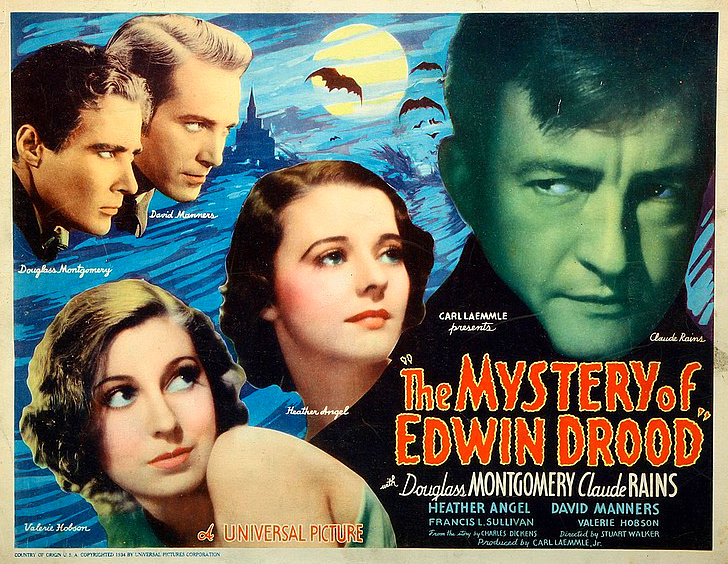
To be the best possible person, we must, each of us, become the authors of our own narrative. To do this, we must first accept that we are stories begun by other storytellers; that our own narrative is but the continuation of a story already several chapters in the telling. We are all Edwin Droods – texts awaiting completion, with no guidance as to how the mystery should to be resolved.
In a very real sense, we are like those authors who took upon themselves the challenge of completing Charles Dickens’ unfinished text. We must seek to understand a text that was produced by others to such an extent that we are able to continue towards a satisfactory conclusion.
That conclusion will remain forever out of reach if we fail to accept that we are developing a narrative already begun by others. Our finales will only be achieved if we are able to incorporate and adapt to this previously written material; make it our own; absorb it into a plot that branches off in directions never originally intended. For this to happen, we must be willing to take responsibility for both the prewritten text and the new text we wish to produce. Only then will our story be the story we wish to write of our lives – the story of our Self.
It is this story which the extremist has refused to write, preferring instead to subsume the Self in that text already produced, to take part as a minor character in someone else’s narrative. And it is only someone else’s narrative that can produce extremist behaviour, for no person sincerely involved in their own text could ever force an ideology – whether religious or political – on another. To do so would, by definition, be evidence of not engaging with one’s own text.
The question, therefore, is to what extent it is possible to be an adherent of an ideology and yet pursue one’s own narrative? Can a Catholic be Catholic and yet also dedicated to the production of a text which is true to the Self and not dictated by a church which, throughout history, has been seen as oppressively doctrinal?
The simple answer is that, in those past ages, dedicating oneself to a lifestyle such as an Augustine or a Francis of Assisi or a Teresa of Avila was only possible through the auspices of that church which others saw as oppressive. (The Catholic Church has always been greater than the sum of its parts.) For those who were not inside the walls of the church, however, there was little chance they would even recognise that there was an alternative to living the life prescribed for them.
Islam is something of a different story.
There was a time, in the very beginning, when the Muslims had a sense of adventure, when they preserved those ancient texts that revealed the wisdom and philosophy of the Greeks – for instance – to the Western world. It was out of Islam that the number 0 came – and ask a mathematician just how revolutionary that was! In Ridley Scott’s wonderful (Director’s Cut) film, Kingdom of Heaven, Saladin (the Muslim) tells King Baldwin (the Christian) that he will send his physicians to aid the leprous monarch. This is no small offer as the medicine of the West was, to all intents and purposes, non-existent – unless leeches can ever be recognised as a panacea. Sufism, the mystical branch of Islam, has produced texts equal to any mystical text of Christianity.
At some point in their history, the Muslims went the way of literalism – a movement that occurred in American Christianity several hundred years later – and so ended the adventure. Literalism, whether as an approach to the Quran or Bible – demands that the adherent forsakes self to word. If the foundational text of a religion is to be read literally there can be no self, for the word always comes first.
If, as we would advocate, the Self must be the writer of the original narrative, even though they start with an already partially written text, then any form of literalism – Christian or Muslim – is anathema to the enterprise of writing the Self. Literalism requires that I whole-heartedly accept that the word of another writer is always and everywhere superior to my word. The writer of St John’s Gospel wasn’t having this! While this Gospel begins “In the beginning was the Word”, it is soon abundantly clear that this ‘Word’ is in fact a person and that through this person all things came to be.
If you wish to read the Bible literally and if you accept that the call to all Christians is to live in the imitation of Christ, then a literal reading of the opening of John’s Gospel undermines everything you can possibly believe about the God of the Bible.
That is, of course, if you believe that the Jesus of the New Testament is truly the Son of the God of the Old Testament.
Jesus was so determined to live a narrative of truth that he was prepared to die rather than give in to those who would impose their text. It is notable that, in acting in a manner that ensured his execution, Jesus took no one else with him. This is the Self in action.
As much as he wished for others to follow him, as much as he taught his followers what he believed to be true, he made damn sure that when he paid the price for his beliefs, he did so alone. No one other than the Self should ever pay the price for the vindication that justifies. This is the fundamental difference between the Self who sincerely writes their own text and those who succumb to the text of another. In order to convince the self that the choice is worth the cost, others must pay the price; numbers become an indication of success. This is the extremist!
Type the word ‘extremist’ into Google and Oxford Languages supplies the following definition: a person who holds extreme or fanatical political or religious views, especially one who resorts to or advocates extreme action.
Doesn’t really say a lot, does it? An ‘extremist’ is someone who is extreme!
And what exactly is meant by ‘extreme action’?
I would suggest that the ‘extremist’ is that person who has so refused the confrontation with the Self that the only possible means of obtaining justification left necessitates action against the largest number of others. Only in such a visible act of power, even if the extremist self is annihilated along with those others, vindicates the existence of a self which lacks its own story to tell. For if there is no story, there is no Self.
There is always an element of physicality in extremism. The bully in the schoolyard is a petty-extremist, imposing the physical self upon others in lieu of a real Self which eludes. The loquacious drunk in the pub who allows none other to voice a thought – especially one contrary. The middle-manager who arranges and organises to their own glory with little thought to the impact upon colleagues. The managers who downsize at the expense of countless others. All of these are petty-extremists, imposing their physical self upon countless others to their detriment, for doing so engenders within the empty shell of the self the only sense of mastery within a story over which they have no actual control.
In real terms, these petty-extremists cause far more loss of life and livelihood than even those who fly planes into tall buildings. Extreme action is, therefore, any action in which a neglected self imposes itself upon as many others as possible for its own justification.
This is an abdication of responsibility for the Self, for those who suffer do so only because the (petty-)extremist determines they do so. This is suffering imposed on others for no reason other than it makes the unjustified self of the extremist feel meaningful – for what more meaning can a life have than its impact upon others?
In truth, the only real meaning of a life is a fulfilment of the Self, but this takes commitment to the telling of a story to its conclusion after it has been begun by others. It is the wresting the narrative out of the hands of others which makes the telling so difficult – for most, too difficult!


Leave a Reply