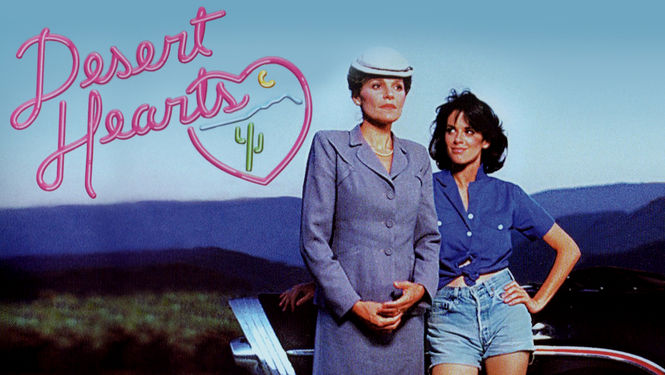
“Other than my books, there’s nothing I’ve wanted.”
Vivian Bell’s explanation to her Reno lawyer of why she wants to leave a “decent marriage” leads to his remarking, “It’s a rare woman who wants out with no strings.” At this point in ‘Desert Hearts’ (1985), Vivian lets this blatant sexism slide. In fact, one of the strengths of the movie is the way that it simply ignores the stereotypes signposted along the way to Vivian’s awakening. There is, in this movie, a simple love story to be told with no strident feminist voice raised.
Vivian’s statement isn’t strictly true. While she may not want any material or financial takeaways from her thirteen year marriage to Martin, she does want something. Not a tangible something to be sure – something far more valuable. Vivian wants to be “free of who I’ve been.”
It’s always easier to recognise what we don’t want; not quite so easy to say what we want instead. Vivian clearly has no idea what she might be looking for. Because of who she is and the way her life has been what it has she likely never imagined the merest possibility of a Cay. In fact, so in control of herself is she, that she’d have never gone to Reno if she’d had any inkling of what was to happen.
It does leave a question unanswered at the heart of the film.
Vivian’s presence in Reno is due entirely to her need to change, to get away from what her life has been. Yet she has no definite idea of the form such a change will take. She is, in this specific way, a tabula rasa, a blank slate awaiting the inscribing of a new text. But, will it be Vivian who writes this text?
Certainly, she is in a position to author whatever text she wishes her life to be. In making the decision to come to Reno, to leave that “decent marriage”, it would seem likely that she, a scholar of literary texts, must have some semblance of a story she wishes to write of herself.
Before she can begin a new chapter, however, she runs aground, caught on the reef, but finding, to her good fortune, the beautiful Cay.
In entering into a relationship with another woman, it might seem that Vivian has indeed taken up the pen to inscribe her own identity, to truly free herself of everything that she had been. This is the illusion of the film, that Vivian (from the Latin vivus) has indeed chosen to live her own text. It is, however, an illusion nonetheless.
There is always a choice to be made in anything we decide to do. It really is more a matter of the range of choices available. If someone holds a gun to my head and orders me to perform an act I wouldn’t normally, that might actually go against all that I hold sacred, I’m likely to claim in my defence, to make it possible for me to live with what I might do, that I had no choice. This, of course, isn’t true. I remain free to maintain my integrity and die from a bullet to the brain. My range of choices may be extremely limited and decidedly unattractive, yet I remain free to choose.
Cay is the gun that limits Vivian’s choices. With an unlimited range, Vivian is unlikely to ever choose another woman. That she does is more a matter of her choices being limited. Cay makes it easier for Vivian to choose the lesbian option by severely restricting the older woman’s range of choices. As Roger Ebert says, “It might have been a better movie if it had been about discovery instead of seduction”.
Having made her choice, Vivian bravely lives her new textuality, inviting Cay to return with her to New York. But, in reality, she has made the self-same choice she came to Reno to get away from. It may be that this time it is Vivian who is the older, more mature partner, as opposed to Martin in the marriage she’s just had dissolved, but, as she finds herself in a relationship largely at the instigation of the other, she is likely to be taking a trip to wherever lesbians go instead of Reno.
Vivian’s story is my story, your story, a story for the ages. Which explains the film’s continued popularity (it is one of my favourite films). Vivian is excited and scared by the radical decision that has so changed her life. In reality, all that’s changed is the person with whom she chooses to live her life. She may have (literally) let her hair down, she may even have experienced a level of sexual satisfaction Martin was never able to give her, but she is living precisely the same text she brought with her to Reno. It is always safer to decide in favour of the other than to risk being alone.
When Vivian arrived in the divorce capital of the United States, she was on the cusp of an epic change. As it turns out, this woman, so used to being in control, only shifts slightly rather than allowing the seismic eruption that would have demanded a truly radical resolution to her story.
The question that remains unanswered is whether Vivian actually loves Cay. This is something which is never said throughout the movie, except by Silver who, for all her apparent brassiness, is the stable, heteronormative centre of Cay’s world. The ending of the movie implies that the first rush of passion has already subsided and the future comes down to hard-headed choices. Hardly ‘Romeo and Juliet‘.
The best we can say for Vivian, then, is that she is co-author of the text yet to be written. It may well turn out to be a story with a happy ending but, for a brief moment, it could have been so different. If she’d been willing to take her initial decision to its logical conclusion, Vivian not only could have freely authored her own text, she could also have provided the hugely needy Cay with the strength and courage to do likewise.


Leave a Reply