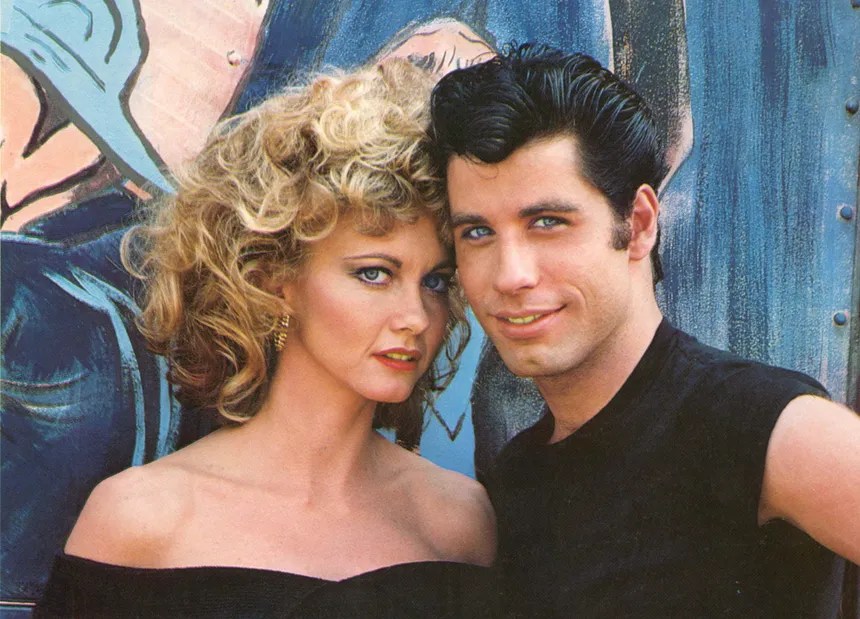
“…this is just an average musical, pleasant and upbeat and plastic.”
Roger Ebert
Though panned by critics, upon its 1978 release, Grease was recognised as fun and a likely hit.
The year before, John Travolta had starred in the smash that was Saturday Night Fever, an edgy, gritty look at the life of a 19 year old from New York. Grease definitely suffered in comparison – at least in the critical view. Whereas SNF is a film of the 70s for the 70s, Grease is a nostalgic trip back to a more innocent age – the 1950s.
Or, so it seems.
No teenybopper star of the 50s ever sang songs with lyrics like those in Grease.
If one makes the effort to see beyond the facade, this film is as much a product of its time as SNF.
Let’s take one of the most oft repeated criticisms of Grease as an example.
It has often been noted that the actors do not look like the teenagers they are supposed to be. And this is obviously the case. In 1978, Olivia Newton John (Sandy) was 30; Stockard Channing (Rizzo) was 34 and Jeff Conaway (Kenickie) was 28. At a mere 24, John Travolta was one of the youngest cast members. It is not unusual for actors to be older (or younger) than the characters they play on screen. What makes Grease stand out is the fact that there seems to have been no effort to at least make the stars appear age-appropriate. Is this just a case of poor casting?
This is a film from the 70s, set in the 50s, with lyrics very much from the 70s. Could it not be that the decision to cast these older actors in such young roles was a deliberate choice to show how much more jaded and grown-up teenagers were in the 70s as compared to the 50s. Whether accurate or not, 1950s America is often portrayed as a Golden Age of innocence and respectability. There is nothing innocent or respectable about the characters in Grease. The one character who appears as if she could have come straight out of the 50s, Sandy, is well aware of the need to grow-up if she is the get the one that she wants.
Which, of course, is another of the oft repeated criticisms of the film – that the girl has to change in order to get the boy. Grease is seen as upholding the patriarchal order of things because Sandy must lose her purity for the benefit of the male. If this were merely a 1970s trip down Nostalgia Lane, this might be a legitimate claim. However, this film is not what it appears to be. Apart from the setting, there is nothing about the film which longs to be back in the 1950s.
Notice that, when Kenickie and Rizzo are making out in the back seat of his car, it isn’t the male who forces himself on the female. When the condom breaks, Kenickie clearly thinks that his chance has gone. It is Rizzo who decides “What the hell?” This is not the action of a sweet, innocent Sandy-type character.
When Sandy changes at the end of the movie, it is not because of any patriarchal pressure, but because she is unhappy with who she is and decides to do something about it. And, of course, this was very much possible in the 1970s – not so easy in the 1950s, when parents still had a lot of authority over their teenagers’ lives.
And let us not forget that Danny does make something of an effort to win his girl’s heart. His wearing of the Letterman at the end is often derided, especially as it is so very soon discarded. But this neglects to take into account his willingness to join the Jocks – anathema to a Rocker like Danny. Danny actually makes considerable effort to change. The problem is that his change is retrograde, a move back in time. This is the wrong kind of change. When Sandy changes, she is changing forward and this is why it is appropriate – nothing to do with the sexism some choose to see in the film.
By setting the film in the 50s yet retaining the sensibilities of the 70s, Grease is a critique of the whole nostalgia industry that was just starting at the time and is still with us today.
Another of Roger Ebert’s criticisms of the film is that he thinks one of its “underlying problem[s] is that it sees the material [the 1950s setting] as silly camp”. “Camp” is defined as “deliberate affectation or exaggeration of style”. It is true that the film packs a lot of stereotype into such a small space – the High School, the Malt Shop, the cars, the Drive-In, the Fair, etc – yet, this is all quite lovingly done, with a real eye for detail. And all this just to make the setting seem real – which is achieved brilliantly. Even if it bares little resemblance to actual 1950s America. It, at least, meets the expectations of a 1970s audience. It is that most elusive of Hollywood Dreams – it is believable (with a little suspension of disbelief, maybe).
Grease is a musical and, by definition, a feel-good movie. But it has a razor-sharp wit and a very serious message at its heart – just listen carefully to Rizzo’s song “There are Worse Things I Could Do”.
This is a film that accepts that teenage girls are no longer Sandra Dee wannabes, anymore than teenage boys are Troy Donahue clones. There is, of course, a price to be paid for this liberation from a by-gone age and Rizzo comes close to paying it. In one of the most powerful scenes of the film, Kenickie, taking responsibility for his actions, tells Rizzo that he doesn’t run away from his mistakes. To which Rizzo replies, “Hey, don’t worry about it, Kenickie, it was somebody else’s mistake.” Rizzo uses her bad girl reputation to save that of the guy who got her “knocked up”. In a patriarchal film, the male character is expected to be noble. In Grease, the female characters get to be just a noble as the guys.
This is anything but a light and fluffy trip down memory lane.
 Mark with an X
Leave a comment