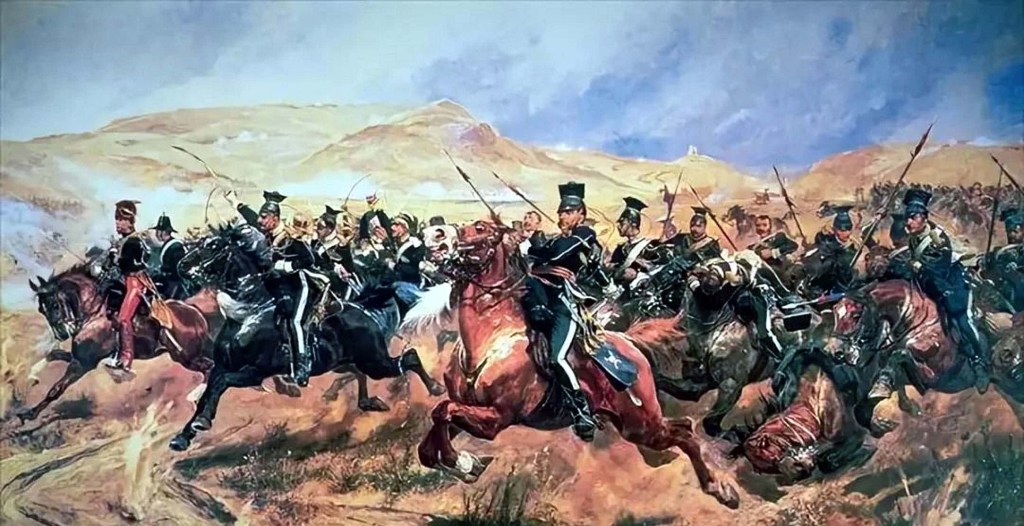
Half a league, half a league,
Half a league onward.
Alfred Lord Tennyson ‘The Charge of the Light Brigade’ 1854
Tennyson wrote ‘The Charge of the Light Brigade’ in dactylic dimeter, an unusual choice for an English poet. The reason for the choice is obvious – if one is writing a poem about charging horses then the dactylic DUM da da provides precisely the right rhythm. In those lines quoted above, one can hear the hoof beats as those horses are ridden boldly and well into that valley of death. The dactyl is a driving rhythm, that, in a sense, forces the reading onward in imitation of the Light Brigade’s charge.
Having chosen the dactylic dimeter, Tennyson had to concede apportioning blame in the course of the poem. Once the charge had begun and the horses at full gallop, there is no opportunity to stop for the pointing of fingers of blame. To do so would require a wholly other poem. In this poem, the focus is entirely centred on the bravery and the duty and the sacrifice of the men of the Light Brigade.
The issue of culpability is mentioned only twice in the poem – at line 6 where we have the issuing of that fatefully vague order ‘“Charge for the guns!” he said.’ and at line 12 where we find the closest we come to a condemnation from the poet, ‘Someone had blundered.’ On neither occurrence is a name provided to identify the source of the order that sent so many men to needless death and misery. This not because Tennyson is unwilling to apportion blame, rather because to do so would be to shift the attention away from where it rightly belongs – foremost and squarely on the men of the Light Brigade.
Similarly, Tennyson names none of these men, even referring to the whole brigade as ‘the soldier’ at line 11. Again, this is deliberate strategy, showing how the whole brigade of well over 600 men acted, in accordance with their training, as one. The anonymity of the individual is a mark of respect for the whole.
For anyone who has never been drilled on a Sergeant Major’s parade ground it might be difficult to accept this individual anonymity as a positive, yet it is this sublimation of the self to the whole which enables the brigade to function according to its purpose, even in response to so vague and disastrous an order.
It is in praise of this dedication to professionalism and the determination to carry out their duty, made manifest in their bravery under horrendous fire, that Tennyson wrote this poem.
There are, inevitably, critics who consider this poem to be one of Tennyson’s weaker efforts and, in fairness to them, it seems the poet wouldn’t disagree with this criticism.
Yet, it is understandable why the poem retains its popularity with a general readership. Even if George Saintsbury was right to observe that ‘at no time was Tennyson a perfect master of the quick and lively measures’ and even if the dactylic dimeter is not consciously recognised, it remains the case that this poem, and probably more than most, has the effect it so evidently does upon the reader precisely because of its poetic meter.
If, as Thierry de Duve so loquaciously put it in his Aesthetics at Large, ‘conceptual purposiveness reflects itself in the empirically perceptible apparent purposiveness of the beautiful form’ – or, as a lecturer once told us, form mirrors content – we can see why this poem succeeds so well, as it’s rhythms carry the reader onwards towards those guns, in a mimetic reflection of the Light Brigade’s charge.
This may seem a ridiculous point, as the cost of reading the poem comes nowhere close to the ultimate sacrifice paid by the men of the Light Brigade that day in October, 1854.
Yet, it must not be forgotten that this is a poem, mere words on a page and that Tennyson has been able to make us feel a smidgin of the excitement and terror of that ride into the valley of Death is a testament to the power of his writing, however imperfect his mastery of the quick and lively measures.
 Mark with an X
Leave a comment