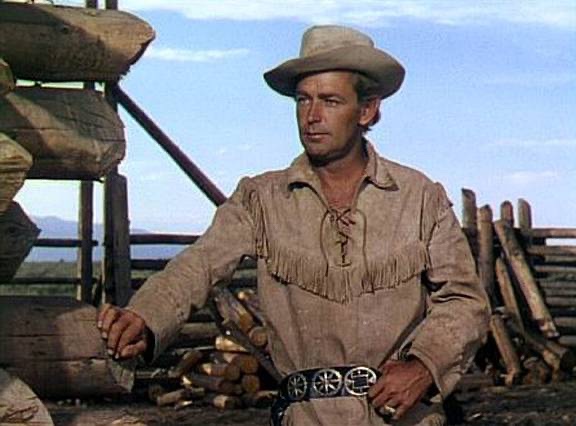
Shane is the first movie I ever saw in a cinema (or, at least it is so in my memory). Not, I hasten to add, upon original release. I can’t remember the year, but I was quite young. We went with the school so, whatever else I might say about education in the Seventies, to it I owe my love of cinema and, to this day, American Westerns.
It seems a strange genre for someone from the Northwest of England to have such a lasting devotion to. Such is the power of first impressions, I suppose.
I rewatched Shane recently – unfortunately, on a much smaller screen – and it is still a great movie; still worthy of having created a lasting love.
Alan Ladd was perfect as the jaded gunslinger who reluctantly accepts his fate and faces the black-clad Jack Palance in order to save the only people who have ever treated him decently, accepting him for who he is and not for what he is.
An aside: when I first saw Darth Vader in Star Wars (1977), I instantly thought of Jack Palance’s gunslinger in Shane.
I think, by now, I have established just how important a film Shane has been to me personally. So, imagine, back in the Eighties, the trepidatious excitement I experienced when one of my all-time favourite movie stars – Clint Eastwood – made and starred in what, to all intents and purposes, was a remake of Shane. In my mind, Eastwood just could never play Shane. And, maybe, Eastwood knew it – so he played Preacher instead.
Is Pale Rider (1985) a remake? Or a re-imagining? Or just a homage? I couldn’t tell you. But the connection between the two films is undeniable.
There is little point trying to establish which is the better film. It is true that Roger Ebert lists Shane as a Great Movie, but Pale Rider gets an equal four stars.
The two films are what I love about story. Of course they tell exactly the same story – but don’t they do so in such different ways? According to Christopher Booker, there are only seven basic plots. Whether he is precise or not, who knows? Definitely a book worth reading for anyone interested in story, though. The point being, there is a reason, beyond the desire for the almighty dollar, why Hollywood keeps making the same movie over and over. There just aren’t that many movies to make. What Shane and Pale Rider show us is that it is possible to make the same movie with distinction; that the same story can be told in an infinite number of ways. All of them of equal quality.
What shocked me in my recent rewatching of Shane was that dialogue between Shane and Joey, when the gunslinger – who must have known that the eventual show-down was inevitable (see one of Roger Ebert’s better reviews) – tells the acolyte, “A man has to be what he is, Joey. Can’t break the mould.” My shock was only a measure of my underestimation of just how great a lie is the American Dream. It was a realisation that not only has the Dream been lost; it never, ever existed.
Even if one goes back to James Truslow Adams’ ideal idea of the Dream, wherein the epitome was the Main Reading Room at the Library of Congress, one has to conclude that the American Dream has always had the same quality of any other dream – forgotten upon waking.
Consider the contradiction between a dream that sees intelligent ‘men’, of all colours and creeds, sitting side-by-side reading for the good of all and the ‘man’ who can’t break the mould. If the mould cannot be broken, there will never be a day in which, as Adams foresaw, the readers will be engaged in “devoting themselves to the good of the whole”.
Truslow espoused his ideal of the American Dream in 1931; Shane, despite the setting, instructed Joey in 1953.
The American Dream is as ephemeral as any other dream.
Though a noble ideal, it remains somewhat incredible that a nation could base its fundamental philosophy on a dream. That said, look at America now. The only ‘superpower’ left. The once and future king of the world. Doomed to go, if history teaches anything, the way of all world powers.
There’s always the hope, of course, that America will be saved by that individual in whom they place so much faith. But Shane is that individual. As is Preacher. And both have no individuality to speak of. Shane, at least, professes his destiny. Preacher never actually does. But he is just as bound by destiny as Shane.
Just as there are, as Roger Ebert recognises, “intriguing mysteries in “Shane,” puzzles and challenges, not least in the title character and the way he is played by Alan Ladd”. Likewise, in his review of Pale Rider, he also acknowledges that “One of the subtlest things in the movie is the way it plays with the possibility that Eastwood’s character may be a ghost, or at least something other than an ordinary mortal.” In common lore, ghosts are spirits unable to move on, making Preacher every bit as moulded as Shane.
While it is not uncommon for American film and TV to speak in terms of Destiny, what they really mean is Fate. Destiny would leave Shane free to break the mould and Preacher wouldn’t appear at the behest of a young girl’s prayer – summoned by the will of another.
As victims of Fate, neither Shane nor Preacher can be the individual who leads the people to freedom. And, in both films, it is only a paltry local dispute which is resolved.
One may be tempted to argue that Shane and Preacher are, analogously, cinematic messianic characters in the vein of Jesus who, ostensibly, actually failed to resolve the local dispute that was Israel’s occupation by Roman forces. This argument, however, is profoundly asinine.
To point out one obvious difference, Shane and Preacher both ride away after the final confrontation; Jesus didn’t survive his.This is a more important point than it might at first sight appear. Shane and Preacher survive precisely because they are not masters of their own Destiny. They both face, let’s face it, insurmountable odds. The ever self-aware Eastwood plays joyfully with the sheer impossibility of Preacher’s situation. Shane makes the implausible plausible, but only due to our willingness to unthinkingly accept Hollywood conventions.
Jesus didn’t survive because he willingly followed his Destiny, choosing freely to walk the path to Golgotha. This cannot be said of either Shane or Preacher. They survive against preposterous odds because they are Fated to do so. Shane was fated to survive, just as Jack Wilson was fated to die.
Shane would have broken the mould by dying.
Just imagine the furore caused by the death of the hero of a 1950s Hollywood movie!
By surviving, Shane accomplished nothing. His death might have inspired the small-holders to rise against their oppressor in defence of their own rights. By surviving, those same small-holders – and others like them – are led to believe they can rely on another to bring them salvation, placing them in precisely the same situation the next time a tyrant decides to take what is theirs.
The true hero of Shane is Joe Starrett (played by the ever reliable Van Heflin). He is the only character who displays any sense of his own Destiny. He is fully aware of his wife’s attraction to the glamorous stranger, but he chooses not to intervene – to do so would serve only to ensure calamity. Starrett chooses freely to go into town to face Jack Wilson. Starrett is Jesus beaten up by the Apostles to prevent him fulfilling his Destiny.
There is no equivalent, in Pale Rider, of the Starrett character. This is, very much, a Clint Eastwood movie, “a film he dominates so completely”, according to Roger Ebert. Consequently, there can be no other possible route to salvation except through him.
Eastwood might have been in the process of revisioning the Western, eventually bringing us Unforgiven (a film which has much the same theme as Pale Rider), but, in doing so, he makes it patently obvious that the possibility of true salvation – that at least makes an appearance in Shane – is no longer an option. In reality, we can see this in the election of Donald Trump as President. Whatever one might think of this turn of events, it is clear that Trump was elected as a pale rider, the saviour who would save us because we are so unable to save ourselves.
Unfortunately, this is the image that America has adopted as its role in the world – the hero who rides into town to save the locals from the nefarious villain. Even more unfortunately, as Vietnam, Somalia and any number of other such endeavours have shown, reality doesn’t work according to a Hollywood script.
Reality cannot be built on a dream.
America will never achieve Truslow’s dream precisely because it has ensnared itself in fantasies of Fate – all the while thinking in terms of Destiny. Such confusion can only lead to the events of January 6, 2021. If Shane and Preacher survived such tremendous odds, how could Trump fail? A man so imbued with the culture of celebrity could never accept his own demise.
 Mark with an X
Leave a comment