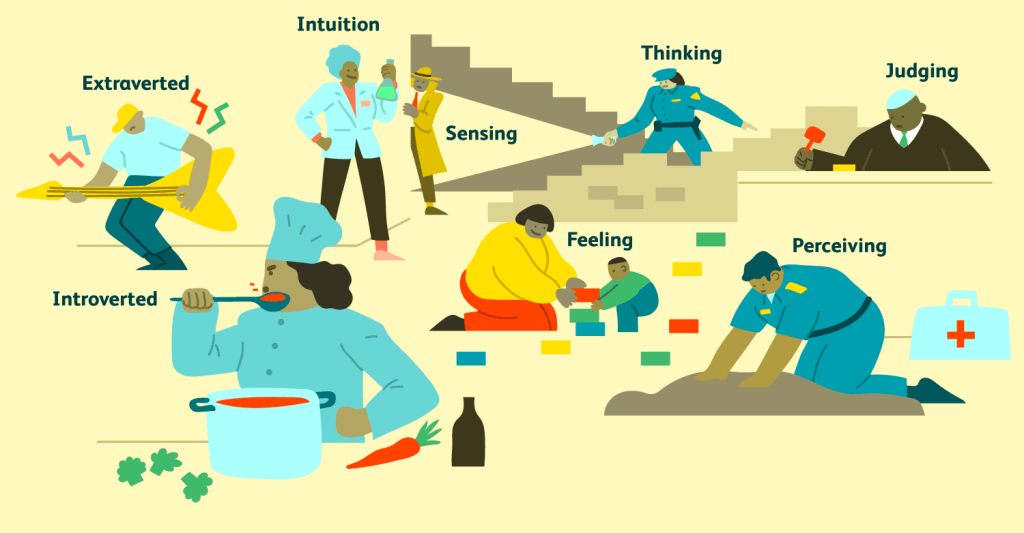
$2billion dollars and 2 million people annually – two numbers to consider when thinking about type because they represent the amount earned from the number of people who take the Myers-Briggs Type Indicator each year. Staggering numbers, to say the least.
The numbers imply that personality typing is an established method of gauging, quantifying and categorising human beings. Just so long as they don’t start tattooing those four letters on the inside of participants’ arms, it’s nothing to worry too much about, right?
And, it’s not like there is no history behind the MBTI. At least since the time of the Ancient Greeks, we humans have sought ways to categorise each other. Understandable, really. If each human being were truly unique, how would we ever have any way of understanding us? Psychology, the scientific study of us, depends upon there being only a limited number of ways to be human. Infinite diversity would make psychology redundant. What are Attention Deficit Hyperactivity Disorder and Bipolar Disorder, for instance, if not typologies?
We categorise in order to deal with and, hopefully, help those who fall into a certain kind of listing.
Yet, there remains something inherently objectionable to the idea that every human being who has, who is, or who will be, falls into a mere 16 types – or, if one prefers the Enneagram, an even more meagre 9 types. How do we maintain any sense of individuality if we are merely one of 16 or 9 ways of being human?
Even more importantly, however, is the question of how many of those 2 million people who allegedly take the MBTI each year did so voluntarily? According to the website marketplace.org, 1 in 5 Fortune 1,000 companies use the MBTI as part of their hiring process. Whatever the actual numbers, that amounts to an awful lot of individuals taking a personality type test they didn’t choose to take. Just how far away from the tattooist are we?
So, we have several questions to consider.At this point, I should pin my colours to the mast and declare that, despite the lack of scientific support, I have a certain liking for the Enneagram and, less so, for the MBTI.
I was introduced to the Enneagram back in the Eighties, in Zambia, while in Catholic seminary, preparing to be a missionary priest. The aubergine didn’t reach the banana plants and so I never became a priest. But those years taught me everything I’ve relied on ever since to get me through my life. And the Enneagram is certainly up there with the theology and philosophy.
That said, if there is one thing in which I am passionately interested, it is the question of how to be individual in a world that really doesn’t want voices speaking in the wilderness?
I went through my teenage years in the Seventies when there was no conception of child abuse, gender or, dare I say it?, individuality. This might sound strange to anyone old enough, or musically aware enough, to know Punk Rock! I would ask you to remember just how quickly the muti-coloured Mohawk became an image on postcards from London. Whatever Punk Rock’s original intentions, it succumbed to marketing forces quicker than the Flash’s sneeze!
It really doesn’t matter what movement one belongs to, or how radical that movement may be, all such entities are merely ways for people to come together to be identified as belonging and, therefore, not individual. The individual does not belong!
And yet…
If the principles of personality typing have validity, then individuals do belong – even those INFPs who make up only 2% of the human race. Though small, 2% of humanity still amounts to some 156,000,000 individual personalities. That’s some group to belong to! Of course, we have a problem with the word ‘belong’, here. Each individual ‘belongs’ to this group only by dint of being identified as having something in common with all those other millions of people. They certainly don’t belong in the sense we might say someone belongs to the Masons or a particular church. Such people belong because they choose to, whereas an INFP ‘belongs’ only as a means of categorisation.
That said, it seems legitimate to use the word ‘belong’ because we could, just as easily, refer to this particular group as the ‘INFP community’, which is a not uncommon form of expression, these days. In the sense in which ‘community’ is used here, we are clearly talking of a widely disparate group of people who choose to be identified with others who share a common trait which makes the whole group distinct from others. There is no sense of anyone belonging to one of these communities out of choice. Community has come to mean little more than yet another form of categorisation – or, we could say, type.
In this very general sense, then, the most radical individual – among whom I count myself – is forced to belong. There are any number of such loose groups, communities or categories to which the individual can be said to belong. Not least of these, of course, is the family. One has no more choice over which family one is born into than one does over any other such societally recognised group.
What we can say, then, is that individuality does not cause separation between the one and the many – any individual who wishes it so is guilty of wishful thinking, at best, and self-delusion, at worst. To be truly individual is to accept that the rest of humanity’s need to categorise – or type – is unavoidable. One will be typed, even against one’s own will.
The ‘gender community’, those who seek the freedom to identify as they will, are currently involved in identifying the parameters which will, in short order, be standardised and become but another expression of categorisation. This hysterical minority will have its moment in the sun, and it will – already has – effect change. And then it will be subsumed into the norm. (The only hope is that, at that point, they will realise the harm and hurt they have caused other individuals!)
So, in some fundamental human way, it really doesn’t matter whether there is scientific justification for either the Enneagram or the MBTI. At least with these systems, one has access to an understanding of how one is being typed – even if one wouldn’t choose to complete the test. The simple fact is, the human community is going to type every single individual member one way or the other.
The answer to the question of how one can remain individual if there are only so many ways to be human is as it’s always been: Know thyself!
Those who scream for gender freedom clearly have no awareness of self. No one who truly knows self would ever need to resort the such hysterical tactics; nor would they need to vilify another individual for holding a view different to their own. The individual is at ease with all those forms of categorisation and type that the human community will impose, simply because they are irrelevant. They mean only what one chooses to let them mean.
The fight for gender freedom is pointless because it will inevitably lead only to a new normalisation.
The radical individual accepts normalisation because there is no way of escaping it – as long as one wishes to remain human. To know thyself is to know that normalisation is merely a measure we all employ in order to make some sense of 7.9 billion individuals. It defines me no more than does the family into which I was born.
Unless, of course, I give away my individuality in order to be seen to belong.
The most radical individual will always be seen as belonging (in the sense explained earlier) to some community or other. The measure of individuality is the extent to which, recognising that these are imposed categorisations, one can live true to the known self.
 Mark with an X
Leave a comment