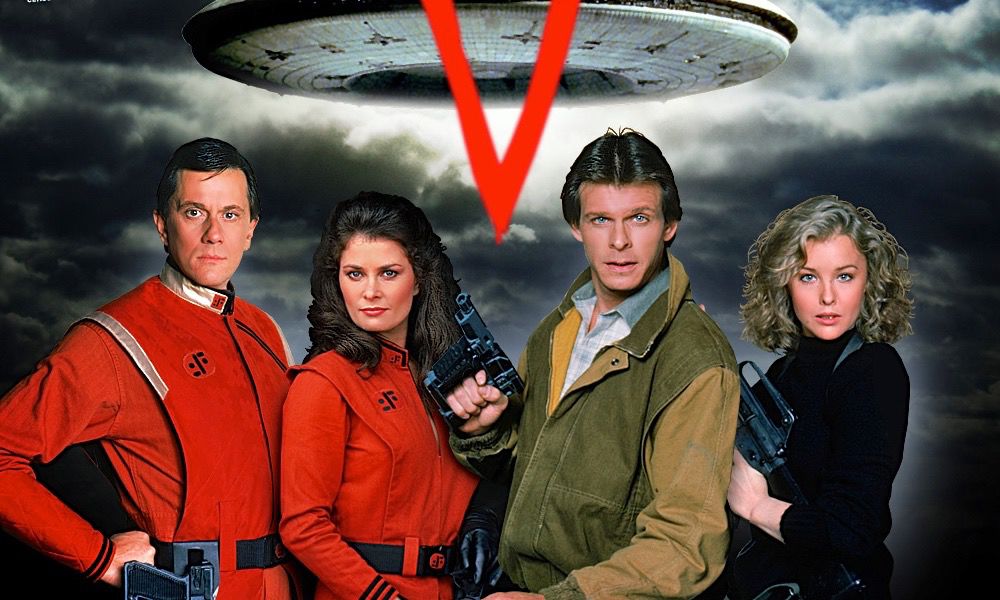
“To the heroism of Resistance Fighters – past, present and future – this work is respectfully dedicated.”
Title Card, V (1983)
When V hit TV screens back in the early Eighties, it seemed like major event television. Looking inevitably dated today, at the time, and for a TV show, the effects looked pretty amazing – one could almost believe a saucer could fly; and hover! When Roland Emmerich pulled the same stunt in 1996’s Independence Day, for those of us of a certain age, it was more a case of seen-that-before rather than the awe it was probably meant to inspire.
The title card quoted above kind of gave the game away so, despite the aliens’ best efforts to convince the people of Earth that they came in peace, the audience knew from the outset that duplicity was afoot – the aliens being, literally, two-faced. One of the great failings of the show, in fact, was the lack of suspense regarding the aliens’ true intentions. Not to mention the sheer gullibility of the humans. The Secretary General of the United Nations might indeed be a brave man, as noted by one character who would soon help to form the Resistance, but, even in the Eighties, it was hard to believe that such an important public figure would just go alone aboard an alien vessel upon the assurance of an as yet unseen alien.
I have rewatched V several times over the years since it’s original airing and am able to do so because it remains fun and because I retain fond memories of its event. That said, it must be admitted that V is not great TV – especially in light of what was to come in the Nineties – notably, The X Files and Babylon 5. Yet, I think, if only in terms of production values, it may well have played a hand in convincing TV executives to invest in quality TV SF. If so, it deserves a degree of appreciation that its story and plot probably don’t.
The characters in V are not depicted in any great depth – they are, rather, types. This is even admitted within the text of the story when Juliet Parrish, the medical student who becomes the leader of the Los Angeles Resistance, replicates the heroic action of the El Salvadorian guerrilla leader Mike Donovan films standing alone against a helicopter gunship, armed with nothing but a pistol. Yet, typically, this scene also reveals another of the show’s weaknesses (or, rather, American cultural prejudices). The male guerrilla leader succeeds in bringing down the helicopter, whereas the aliens faced by Juliet Parrish are chased off by another alien craft piloted by Mike Donovan and gunned by Sancho Gomez. The woman may be inspirationally heroic but it takes a man to make the kill. Types rather than characters.
One of the better aspects of V was the variety of types it portrayed. As just mentioned, Donovan’s gunner is Mexican; his sound man when filming is Tony Wah Chong Leonetti. Caleb and Elias Taylor are two key members of the resistance – and, with names like that, we don’t need to specify their colour, do we? Granted, each ethnic type is more stereotype than individual – the wealthy are all white and the Mexican has experience of smuggling people across borders. But there are transgressions of these stereotypes. Sancho is a brave man who takes a beating and comes back fighting; the Resistance is led by a woman; the Catholic priest learned battle strategy from the guerrillas in South Africa – whoever they may be! (The only guerrillas in South Africa were the Boers fighting the British in what is popularly known as the Boer War. This might appeal to Americans considering their War of Independence against the same enemy. However, it is the Boers who created Apartheid and subjugated the black population of South Africa for over forty years. Makes one wonder just what ‘Resistance’ means in the American mind. Not to mention whether resistance is only allowed if it is led by white people!)
The Eighties wasn’t a time for cultural revolutions but V did it’s best to challenge without upsetting the cultural norms of the times. Under the circumstances it did a pretty good job of it.
Yet, still, it is a show of types. What V succeeded in doing was showing how type is something we can, as human beings, look to for inspiration. We err these days in looking to individuals for role models. The problem is that none of us know who these role models are until they fall and then we are informed by the media that, despite whatever personal pain they may be experiencing, their greatest crime is letting down all those who didn’t know they were looking at them as role models.
We don’t need specific individuals to be role models – whatever one of those may be – we need types, generalisations, (dare one say it?) stereotypes.
Think of three truly great inspirations.
Jesus of Nazareth, Charles Darwin, Martin Luther King.
That’d be my three. In that order.
Look at the lives of these three. As individuals, not always as inspirational as we might like. No individual lives a blameless life. Why put a person on a pedestal they will, almost inevitably, fall off? Don’t look to individuals for your model of how to be individual; look to types. And V offers us the very types we need.Juliet Parrish is the obvious place to start. Her name reveals something of her type, named for both the heroine from Shakespeare’s great tragedy and a tier of local government or church community.
As the tragic heroine, Juliet is subject to outside influences that deprive her of all that she loves; as ‘parish’, she facilitates the coming together of a group of disparate people.
Juliet – the heroine of Shakespeare’s Romeo and Juliet – is a beautiful woman who, nevertheless, is making her way through the male dominated world of science. All she holds dear is taken from her – this is important – she doesn’t lose anything; it is literally taken away from her by the Visitors, just as Shakespeare’s Juliet had everything taken from her by the social forces of the day. Like her Shakespearean predecessor, V’s version decides to fight for what she believes to be the right thing, to regain what was hers, and, in the process, enable others to get back what was theirs. This is why she is a parish, a community, (again, dare one say it?) a mother. She, more than anyone, gives birth to the resistance.
Juliet Parish is not a great character – not a Madame Bovary or Anna Karenina, or even a Katniss Everdeen. She is a type, a representative imagining of one way to be human. This is one advantage of types – they are so general that specifics, such as sex (let alone, gender) are irrelevant. Juliet Parish is a woman only to give this most softcore of SF an edge – even if it’s only the kind of edge one’d find on a plastic picnic knife. As type, Juliet Parish is human rather than woman; she is that person who, in an emergency, gives us at least some hope of getting out alive. Today, of course, we would castigate her for the lives that were lost rather than those that were saved; condemn her recklessness; vilify her arrogance. But only because we have become so undiscerning we no longer see even the most basic distinction between flat and round characters. We insist on seeing everyone – including fictional characters – as individuals and we rail against them as if they have done us real harm when, in fact, they are merely templates to be used to our own best advantage – who ever simply nicks a template without making some design changes to make it better suit personal needs? Juliet Parish is a template of a leader – not a superhero, not a Schwartzenegger, and certainly not a role model. What she does do very well is show us how an ordinary human being can, under the most extraordinary circumstances, rise to the occasion and become not only more than they’ve ever been, but precisely what is needed to enable others to rise above themselves as well. This is the advantage of types – they are so broad that they demand nothing from anyone; yet, they offer something to everyone.
There really is no such thing as a role model. Take Marcus Rashford as a random example. This writer knows nothing of this admirable young man and nothing written here is meant as disparagement of his inspiration to those who hold him in some respect. Indeed, this writer is one among them. My concern is that we look to Mr Rashford as a person, a role model. God forbid this will ever happen, but imagine what is going to happen to this footballer if he puts a foot wrong? Yes, he has put himself in the public domain – because he is brave enough to do so. In doing so, he has placed himself in an impossible position, for, now, he will have to be without blame. The minute he appears to fall short, he will be given over to the modern-day maenads who, in time-honoured tradition, will rip him limb from limb. And why? Because they look to him as a real human being whom they pretend to know, when, in fact, he is a type, an example of how we can be. If we see him as such, any foibles that might appear ( he is human, for God’s sake) will matter not at all because he showed us something good about ourselves – and, if only we were honest, we would recognise that being good doesn’t require us to be perfect.
Mr Rashford deserves our respect and I wish him all the best. And because I see him as an example rather than a person ( I don’t know the guy), my respect for what he has achieved will never diminish.
My point is that we need to stop looking to celebrities as real people – they aren’t! They are characters in a work of fiction. Some, like the Kardasians make this work for them. There are many more who find it an impossible dream.
 Mark with an X
Leave a comment