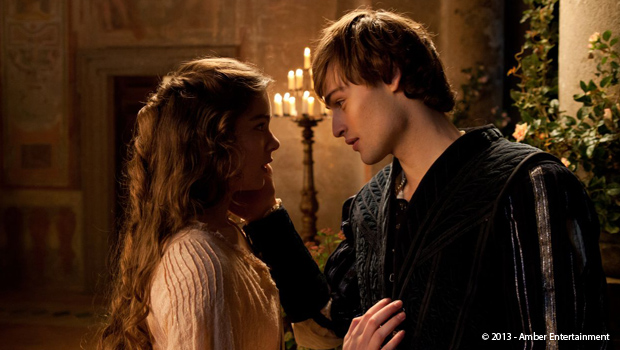
Ah, romance! Don’t we all long for a touch of romance?
Maybe this is why Romeo and Juliet has long remained one of Shakespeare’s most popular plays. And this despite its not being very romantic!
Let’s be honest, outside the orchard, when the people with whom Romeo interacts are not out of reach, standing on a balcony, he is neither romantic nor particularly successful – unless his ability to out-fence both Tybalt and Paris is some measure of success. Of course, by Tybalt’s standards, Romeo’s prowess with his rapier is a sign of his manhood. But, as he kills more people than he has sex with, this doesn’t help the play’s standing as a great romance.
Burton Raffel, in his Annotated Shakespeare edition of the play, warns us, in his Introduction, that “It is a mistake to believe either that Shakespeare’s Romeo is excessively passionate or that he and Juliet are in some way recklessly immature and unthinking.” Apparently, their behaviour is appropriate to the times. Unsurprisingly, the Renaissance had different views on love than we do today, so we should judge the two young lovers with care. Fair point – who would judge the dead by the standards of the living?
However, that said, and despite recognising any reading of the text must misunderstand its context (Who of us can keep Renaissance conceptions of love in mind when reading or attending the play? Who of us would want to?), Romeo is one of the least romantic characters in the annals of great literature. Romeo is – goddamn him! – a man! As much as I hate acknowledging the fact, there is no denying that Romeo is nothing more than a man trying to achieve that which all men inevitably fail to achieve.
The most foolhardy thing any man can do is fall in love with a woman. If love had existed in the evolutionary environment of adaptation (EEA), it is likely that homo sapiens would never have made it out of Africa. That we now, largely thanks to this play by Shakespeare, think that romantic love is some pinnacle to be aspired to has led to this point in history where to be ‘male’ is to be ‘toxic’.
To be fair, it isn’t Shakespeare’s fault that his play has been misread as a guide to love. However understandable that might be.
Romeo and Juliet is a play about changing times and changes in our approach to life.
When first we see Romeo, he is mooning over Rosalind. This is the image of a chavalric Knight from the Middle Ages – to love from afar, to achieve great deeds, to hope to be looked upon with favour.
No doubt there were shannigans that went on in the Middle Ages – aren’t there always when men and women are involved? But the Romeo from the beginning of the play, for all that he loved Rosalind (and let’s take him on his word as a knight), would never have acted the way he does after meeting Juliet. It is, indisputably, the woman who changes the man. For the tragedy of romantic love is that the male will do stupid things in the hope of acquiring that which once he could only fancy from afar. This is the change that Shakespeare encapsulates in this play – not romance, as we understand it today (influenced as we are by our misreading of this play), but that move from loving from afar to taking hold of the desired. Which Romeo does only because the female, Juliet, makes it obvious, even to his dull brain, that it is what she wants.
For all the great poetry of the balcony scene, Juliet’s being situated above and out of reach is appropriate to her role of knight’s Lady. However daring the words spoken, the gulf between them isn’t just that between Montagues and Capulets, it is the separation society enforces to keep the likes of Romeo out of the boudoirs of the likes of Rosalind and Juliet. Rosalind maintained the separation and left Romeo mooning; Juliet descended from the heights and left Romeo dead.
This is more a criticism of Romeo than it is of Juliet.
That Shakespeare was able to write Juliet the way he does implies that women were fully conscious of their patriarchal constriction and that some, at least, were willing and brave enough to challenge societal expectations. Juliet knows that her father has her husband all lined up and that her life is all mapped out. She chooses to follow her heart and thus disobey the authority that held her very life in his hands. This is her greatness – for no individual should be so bound by another as to be devoid of choice.
What makes Juliet such a great character is that, though she does indeed follow her heart, she doesn’t do so blindly.
But let’s set the scene a little.
Examine that scene in the orchard – usually called ‘the balcony scene’. Shakespeare, however, clearly locates the scene in Capulet’s orchard. The shift in perspective is significant. The balcony directs our focus towards the house, the built and civilised, the human. If, instead, we take Shakespeare’s stage direction as our focus, we see a male and female couple in a garden – orchards being planted rather than naturally occurring – at a point when the male is about to do something stupid at the behest of the female. If we don’t focus on the balcony, we cannot escape the allusion to Eve and Adam in the Garden of Eden. But Shakespeare never simply took a plot or an idea from any source. Even the bible gets Shakespeared!
Juliet is rational and in control throughout; Romeo only ever reacts to her.
Take this exchange:
Juliet
How camest thou hither, tell me, and wherefore?
The orchard walls are high and hard to climb,
And the place death, considering who thou art,
If any of my kinsmen find thee here.
Romeo
With love’s light wings did I o’erperch these walls,
For stony limits cannot hold love out;
And what love can do, that dares love attempt.
Therefore thy kinsmen are no stop to me.
Juliet is concerned with realities – the height of the walls, the danger; Romeo is concerned only with the romance. That she has lost her heart to Romeo, there is no doubt, but it doesn’t cloud her sense of the real. Even that lovely speech, slightly earlier, when she ponders the importance of a name, is purely rational, without illusion. The same cannot be said of Romeo – he is besotted by the illusion.
Dare one say that this is Shakespeare – he strives to make us see what we might prefer not to. If this scene is, indeed, an allusion to the Garden of Eden, then we must revise the traditional interpretation of that fall. Rather than the bitch who got us thrown out of Paradise, Eve becomes a Christian version of Prometheus – the bringer of reason to the human race. The bible does, indeed, get Shakespeared!
The problem is Romeo. He is the reason this play is a tragedy. To answer that question every Secondary School student must face, it is Romeo who causes the death of Romeo and Juliet!
Romeo is besotted and there is no worse state for a man to be in.
Men are aggressive and there are, of course, consequences of this that have hurt women throughout history. But there is no easy answer to this problem. Today, we label that male aggressivity as toxic. But what must a man do to avoid toxicity? For, according to this play, even if he forego his natural attitude, the female still ends up damaged and dead. Not to mention all the other death and mayhem in this play. A romance? Really?
The problem with Romeo is that he is forced to play a man’s role despite Shakespeare having swapped the stereotypical binary opposition between male and female. If there is a romantic scene in this play it is the so-called “balcony scene”. But, as we have already noted, Juliet is given the more ‘masculine’ voice in that scene, while Romeo is the more ‘feminine’ – maybe not in any actual way; more in the sense of she speaks the cultural conception of the masculine to his feminine. If Juliet was running around in the streets, as Romeo does throughout the play, one can’t imagine half the mayhem as results from Romeo’s ineffectual – and, indeed, down-right destructive – ‘passions’. With Juliet’s heightened sense of danger, previously mentioned, can we imagine her responding to Tybalt’s belligerence the way Romeo does?
This gender swap is even in evidence in the tomb as the tragedy unfolds. Romeo, having heard that Juliet is dead and typically not pausing long enough to give the matter any thought, rushes to the apothecary and purchases a vial of poison. Despite the deadly weapons he carries and shown a willingness to use, for the killing of himself he selects the woman’s weapon. Juliet, it is, who commits the honourable death, killing herself with the knife Romeo can’t use – doesn’t even think to use – on himself.
If we consider how soon Juliet revives after Romeo’s death by poison, we can safely conclude that if he had hesitated at any point, given his actions some thought, considered whether, objectively speaking, a woman he had known for so little time, was actually worth the ultimate sacrifice, the tragedy would have been averted. But, Romeo never for a moment, gives any thought to his actions, which, in some ways is typical of a young male, to be expected even. Except, in this play, he is shown up by a thirteen year old girl who does demonstrate, to some extent – though not when it matters – the ability to consider issues greater than herself. One can excuse Juliet’s actions in the tomb far more easily than Romeo’s. She awakens to find that her husband has taken his life for love of her; it is almost incumbent on her to follow suit. If only he had delayed…
Shakespeare, of course, being the businessman he clearly was, has little option but to lay stress on the social consequences of the deaths of Romeo and Juliet. He warns the audience, in the Prologue, exactly what is about to happen, just as he emphasises the social good that results from the tragic events at the end of the play. Shakespeare’s audience were not ready for a Juliet who fully voiced the rational point of view that leads to disobedience of the most powerful authority in her life – her father – but this she can do because we know that she won’t get away with it; that she will be dead by play’s end. In a way, this is one aspect of Shakespeare’s greatness, that he was able to explore possibilities, make his audience think – unlike Romeo (who shows us the consequences of not thinking) – without ramming his ideas down his audience’s throat. The reason students are still having to face that question of responsibility is that Shakespeare left it almost entirely up to his audience to make up their own minds. And this is why we read Shakespeare today; not because the plot is in any way relevant, but because the ideas and the lack of direct blame are. Shakespeare doesn’t give us a text in which he enforces his ideas of right and wrong; he gives us a text that forces us to confront questions that still require an answer – because he never does give us any suggestion as to what we should think – only that we should.
 Mark with an X
Leave a comment