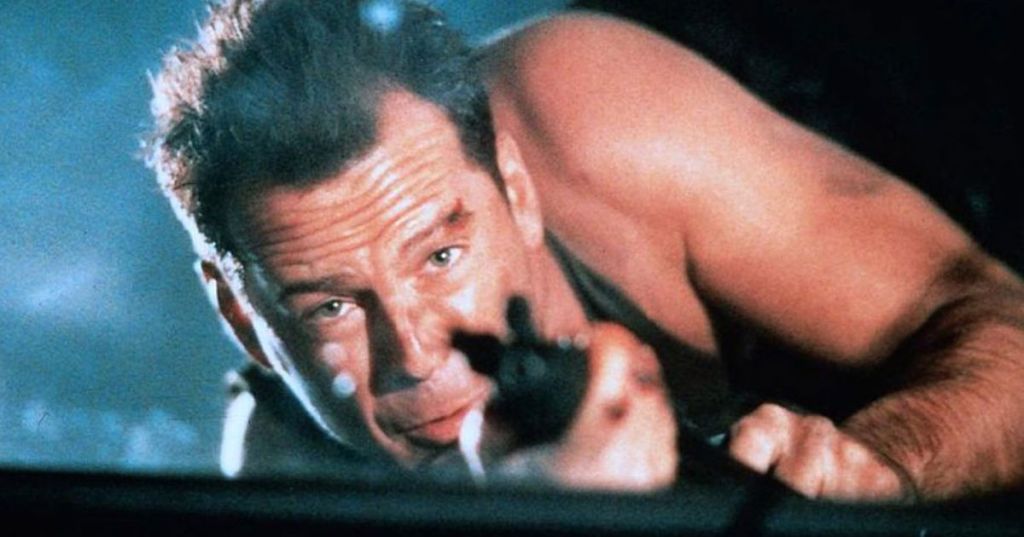
As the Christmas season approaches, it behoves one to trot out at least some of the tried-and-true Chrimbo tunes and movies to help engender the appropriate degree of merriness. Where better to begin our preparation for the Season of Goodwill to All than with that perennial favourite ‘Die Hard‘, a film which is so full of the Christmas spirit even dead terrorists get their very own Santa hat?
The debate over whether ‘Die Hard’ is, in fact, a Christmas movie is a long and bloody affair. Points in its favour are that it is clearly set in December, John McClane is in Los Angeles for the Christmas holidays and Nakatomi Corporation is throwing a Christmas party. Points against, well, not the least of these is that the film was released in July in the U.S. – not the most Christmassy-month of the year!
There is another somewhat significant factor mitigating against the film’s being Seasonal fare. This is a matter of how the film deals with race. It is evident that some considerable thought has been given to the issue; just not so clear what we’re supposed to read into the various portrayals of race and nationalities that appear in the film.
Take the Japanese, for instance. They are clearly guilty of usurping America’s place of economic preeminence in the world and destroying families and core values at the same time. Such is the enormity of Japan’s crime against the natural order that positions American values above all others, that, despite his sartorial elegance, Takagi is summarily executed without trial and immediately becomes a “that” to be disposed of like so much garbage.
A technicality might be argued here in that it is a German who kills Takagi and not an American. But, this actually only serves to show that what those nifty nips are doing to the U.S. they are also doing to the whole of the Western economic system. It is a well-known fact that even during a war, enemies can still find it within themselves to share a moment of commonality. And, so, just as the Germans and Allies would meet in no-man’s-land for a friendly game of footie during the Christmas lull in mass-butchery, so, in Die Hard, the Germans lend a friendly hand by dispatching a shared foe.
Does this cute touch of camaraderie add to the Christmas spirit of Die Hard? Well, hardly!
There is the less than salutary way in which the film depicts African Americans. There are three black characters of note in the film: Al, the LA cop who provides John McClane with the moral support to keep going; Argyle, the first-time chauffeur who drives McClane to Nakatomi Plaza; and Theo, the computer-geek member of Hans Gruber’s band of merry thieves.
The dynamics here are interesting: Theo, being black, can’t be part of the badass, gun-toting action team and, anyway, it’s good to portray African-Americans as smart, right? Yet, however smart he is, Theo cannot make the actual break-in happen; for that Hans gives us the FBI. In other words, we can’t have a black man being too smart!
When discussing the black characters in the movie, dare we say that we should use the term “man” somewhat fluidly? Certainly, the “manhood” of each of the three is suspect.
Theo, as noted, is more ‘geek’ than ‘macho’ and is ultimately knocked out cold by a barely more than limp-wristed punch from Argryle. This is so obviously the first punch Argyle has ever thrown in his life and it hurts him as much as it does Theo. Clearly, Argyle, too, is no fully-paid up member of the testosterone brigade. And, lest we not notice, well, let’s notice that it is a black man punching another black man! Is this a commentary on how most violence against young black men is perpetrated by other young black men? Or, more likely, a simple fear of showing a white man beating down a black man, especially, as would seem the most likely alternative, the ultra-macho McClane knocking out the computer-savvy smartly-dressed young and black Theo – or, white-cop violence against African American male.
Theo, as it turns out, is the lucky one for he is the sole-surviving member of Hans Gruber’s pseudo-terrorists. The only one we actually see leaving the building is the blonde-Aryan Karl, but he only gets to take a step or two before he’s blown away by Al, the desk-driving cop.
Whereas we could not have Theo as part of the gun-toting bad guys because we don’t want to see black men too negatively – he might be a baddie but he’s only geekishly bad, not violently crazy-bad like that blonde dude! We can have Al gun down Karl because of the uniform – sure, he might be black, but he’s a police officer. And the white guy’s a Nazi anyway! What could be more perfect for what is clearly both a religious and a sexual moment in which Al gets to re-establish his manhood?
Al once shot a kid and hasn’t drawn his weapon since – which, in the world of Die Hard, makes him less than a man. The act of shooting Karl doesn’t just save McClane’s life, it is also redemptive for Al.
Overall, then ‘Die Hard’ is so devoid of Good Will that it hardly constitutes a Christmas movie – unless, that is, one is a white, Anglo-Saxon American who believes the rest of the world has got it in for the U.S. In which case, John McClane may just well be a kind of Santa Clause, delivering all that one might wish for Christmas.
 Mark with an X
Leave a comment