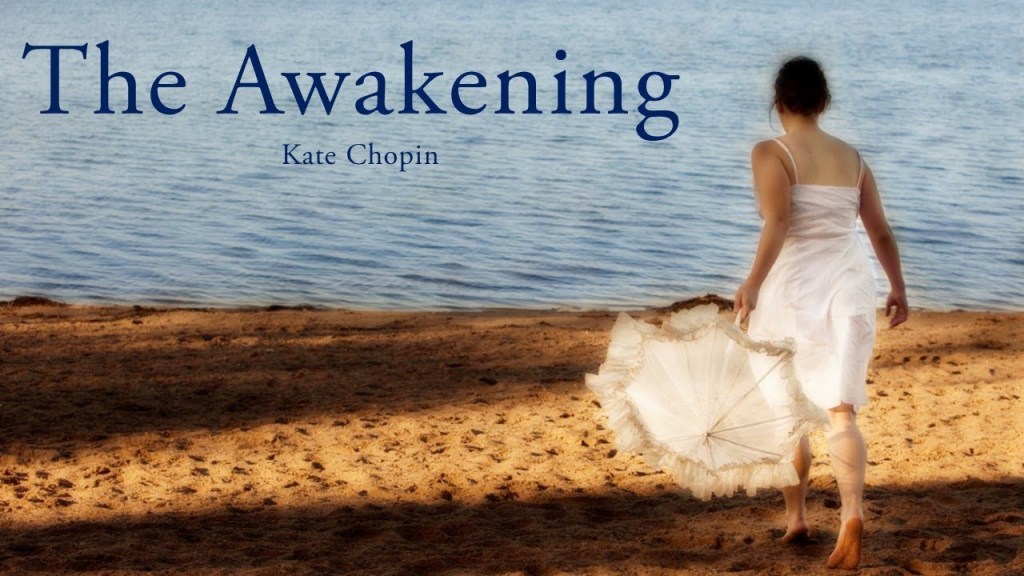
Considering its place in the feminist canon, it is amusingly ironic that Kate Chopin’s rediscovery, in 1969, came about because of the work of a male student. In truth, though, it must be acknowledged that his work benefitted by coinciding with feminism’s second wave* and its interest in reclaiming female novelists lost because they failed to meet the standards imposed by the patriarchal hierarchy. That this novel was tossed aside as so much chaff is as great an indictment of those traditional structures the feminist movement sought to undermine as anything could be. ‘The Awakening’ stands as a towering achievement by a writer who rounded out the 19th century by expressing the woman’s pride and the prejudice of those who would deny her.
The awakening of the title is Edna Pontellier’s growing awareness that life – and her life specifically – should be more and not simply a blind compliance with societal norms. Edna, the protagonist of the novel, is married to Leonce, a businessman who is very conscious of the opinions of others. This hyper vigilance of how others might perceive him may stem from Leonce Pontellier being a Creole. This is mentioned only in passing in the novel – “Mrs Pontellier, though she had married a Creole, was not thoroughly at home in the society of Creoles…”. To be a black man and a successful business man, to boot, requires of Leonce a strict conformity to the dictates of those white men he seeks to emulate. Though he doesn’t come across in the novel as a daring, independent thinker, it is nevertheless true that he marries a white woman – an act that only a few decades earlier would have had him lynched by an angry mob. It may well be that Leonce married Edna as just another step up the ladder to the success he sought in what would still be a predominantly white world. While the marriage might have been accidental on Edna’s part, it was, in all likelihood, very deliberate on Leonce’s part.
When asking at what point Edna’s awakening began, we must consider to what extent a dawning awareness of her role as a rung on a ladder up which her husband is climbing had to play? It’s hard to think how Edna’s awakening wasn’t inevitable. What self-respecting person – this not being a specifically female experience – could live with the knowledge that their existence is reduced to their utility for another? To the extent Leonce buys into the white patriarchal order that will best serve his own personal goals, he serves as the embodiment of Edna’s entrapment. That he, of all people, should have known better, is the greatest indictment against him.
In one sense – as a victim of his time – Leonce can hardly be expected to act any differently. But, this only serves to emphasise Edna’s bravery in deciding to stand up for what she desires for herself rather than conform to what is expected of her. Of course, Edna never for a moment considers herself brave, for she never consciously considers her decisions, and consequent actions, as anything other than something she needs to do. She is aware that she is breaking with societal norms, yet she is so caught up in her own needs, she has no thought of the greater implications and consequences of her actions. This, of course, has to be the case for her story to be a tragedy; if she ever considered herself as a role-model – let alone, a feminist icon – she would have less motivation towards suicide. A person who sees their life as valuable in itself has less reason to want to obliterate it. Edna, however much she awakens, is unable to find value for herself. Hence, after Robert Lebrun leaves for the second time, Edna is confronted with a future in which she has cut all ties with what might have held her together. Her options – now that she has options – are too limited for her to envision a future in which she will achieve the fulfilment she craves.
There is nothing, in this life, which could possibly enable Edna’s successful awakening. It is the human tragedy that we can never attain fulfilment unless we are willing to adopt, like Edna, the selfish drive to pursue one’s own goals at the expense of those with whom we share our lives, while always remaining in need of human contact with those others. This, in the end, is precisely Edna’s dilemma. It is in her moments alone that she realises that she desires something more. Never able to learn to swim when assisted by others, she suddenly learns for herself and immediately swims out to sea, moving even further away from the other Grand Isle vacationers – including her husband. Of course, not only is this moment so central to her burgeoning awakening, it also foreshadows her eventual end. She begins and ends in the water. Alone.
While it is usual to apportion a certain amount of responsibility to Adele Ratignolle, the Creole woman whose explicit femininity is said to be the catalyst to Edna’s awakening, in reality it is more her relationship with Robert Lebrun which is more directly responsible. This determination to paint Madame Ratignolle as Edna’s muse in her search for selfhood can be understood as a need to see her as the tragic heroine who dies for having the temerity to stand against the restraints of patriarchy. No male required, if you please!
One doesn’t need to be paying too much attention to recognise that Edna spends far more time with Robert during her stay on Grand Isle than she does with Adele. Clearly, the attentions of this flirtatious and attentive young man (he is about two years younger than Edna), cannot help but flatter a woman who had all but given over her life to being but a wife and mother – however much she feels herself unsuited to the role. Interestingly, however, it isn’t until Robert does the decent thing by leaving for Mexico that Edna really falls in love with him. He leaves because he realises that his annual game of attaching himself to a married woman has led to his falling in love – hoisted on his own petard, indeed! Edna reciprocates Robert’s playful attentions without allowing any transgression to occur. After his departure, however, she is left to develop the relationship in her imagination and it is this imaginary Robert with whom she falls in love.
As we are all doomed to discover eventually, the reality of our loved ones never lives up to the exciting romantic image we form of them. And, upon his return, Edna realises that the Robert she wants close to her more than any other person will, one day, leave her and, indeed, “the thought of him would melt out of her existence, leaving her alone”. With Robert before her in the flesh how could she keep the imaginary lover alive and vibrant?
Far more than Adele Ratignolle, it is the Robert of her imagination who truly spurs on her awakening, just as it is another man – Alcée Arobin – who gives it physicality.
In the end, realising that there is no true fulfilment awaiting her at the end of her quest, Edna Pontellier – the woman who doesn’t “want anything but [her] own way” – must face reality. She never will have nothing but her own way. And so she returns to the sea, standing “for the first time in her life…naked in the open air”, returning herself to the womb – Aphrodite in reverse as she enters (instead of rising from) the “foamy wavelets”.
 Mark with an X
Leave a comment