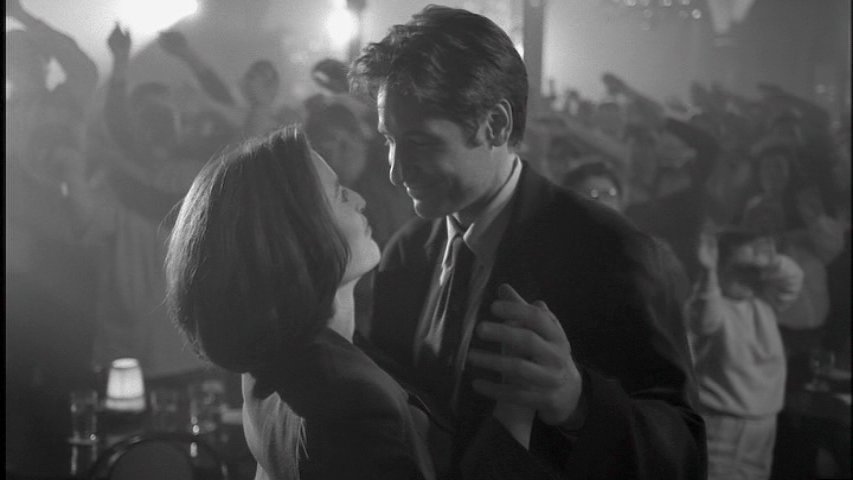
‘The Post-modern Prometheus’, from Season Five of the X-Files presents us with something of a controversy. The plot involves a doctor working in isolation on the Hox gene – the gene which ensures that the correct structures form in the correct places within a body. Unbeknownst to said doctor, his father has been conducting experiments of his own, resulting in the births of a significant proportion of the town’s population who display animal characteristics – indeed, part of the fun of this episode is identifying which character manifests which animal. Just to add to the mix, another character, known as The Great Mutato, obviously an early experiment gone disastrously wrong, is seen dancing to various Cher songs as these inseminations are taking place.
Dr Pollidori is obnoxious and arrogant in the extreme; a man all too aware of his own impending greatness. On the revelation of the mysterious pregnancies, we cannot but suspect Polidori as the culprit. We almost what him to be guilty, as it would justify and vindicate our intense dislike of the man. When he does receive his comeuppance for the crime he does commit, we are relieved, as much for the sense that our hatred wasn’t misplaced as for any sense of justice being served.
At the same time as the episode displaces our negative feelings onto the wrong man – Polidori’s crime-according-to-law, while murder (indeed, patricide), is not the crime at the heart of the plot – it performs just as good a sleight-of-hand by diverting our sense of outrage away from the rapist’s accomplice. The Great Mutato warrants our sympathy to the extent that his existence is an abomination. This is not to condemn those rare unfortunates who happen to be born with craniodiaphyseal dysplasia it is rather an acknowledgement of Mutato’s genesis as a result of a crime against nature. Just as the creature, in Shelley’s novel, is the result of a act of unnatural creation.
The Great Mutato is a dual-allusion – visually to the film ‘Mask’ (hence, the homage to Cher) and situationally to Frankenstein s creature in Mary Shelley s novel, from whence the title of the episode comes. In character, Mutato seems to have more in common with Rocky Dennis, the boy featured at the heart of the story of ‘Mask’. Except, of course, that Rocky, a warm and loving human being, apparently didn’t participate in the rendering unconscious and then insemination of an unknown number of female victims. Not to mention the fact that Mutato does so participate almost gleefully, as he dances to Cher’s rendition of “The Sun Ain’t Gonna Shine Anymore“. While Mutato, unlike Frankenstein’s creature, doesn’t actually kill any one, in this he is as callous towards human life as his predecessor.
It has been argued around the Web that the Great Mutato is innocent of rape because, firstly, no actual rape occurred, and, secondly, because the act of insemination was conducted by the old farmer – who, inevitably, pays for his dastardly crimes by being killed off, by his son, no less.
In all this, there is a convoluted correlation to the inspirational source. Justine Moritz is adopted into the Frankenstein household and, though a maid, is, nevertheless, loved. Justine, whose very name tells us that she will just miss out on justice, is taking shelter because she has arrived after the gates to the city have been locked for the night. While she is sleeping in a barn, the creature, after having killed William Frankenstein – Victor’s young brother – discovers her and slips a locket (which he took from his victim) into Justine’s pocket. This is the evidence that is used against her when she is tried for the murder of the young boy. A crime for which she is hanged. A fate from which Frankenstein could have saved her, if only he was man enough to admit to his actions, revealing what he had created. What we have, depicted in 19th century literary imagery, is a scenario in which the female is punished for her own violation. Because of the way in which Mary Shelley describes Frankenstein’s ‘rape’ of nature in order to find the material he needs for his unnatural procreative act, earlier in the novel, we cannot but see Justine as a victim of rape – she was penetrated by the male (even if it was only his hand into her pocket). Just so, Old Man Pollidori is guilty of rape even though he doesn’t have sex with his victims. He is male imposing his will upon the helpless female; his is an act of male penetration of the subdued female: rape!
So, is the Great Mutato as guilty of rape?
Whichever way one wishes to look at it, the Great Mutato is an accomplice of Old Man Pollidori. There is no sign of Mutato being of diminished responsibility; he is able to recognise that what he and his ‘father’ did, was wrong (“What we did was wrong…”), though, as is the instinct of any criminal, he denies it, “Despite my appearance which you see is quite horrible to the human senses, I … have never acted to harm another soul.” This is a problematic phraseology.
On the one hand, it can be claimed that the Great Mutato is accurate when he states he never harmed another soul. After all, the women who become pregnant from their rape, accept the child lovingly. Despite the way in which they became pregnant, the ’soul’ of the mother is clearly unharmed. But, if we could ask the murder victim if they minded being dead and they admitted that, actually, they were loving it, would this make the murderer any less guilty? That the women are able to love their offspring is a testament to their loving nature; it is not an exoneration of the rapist!
But let us not ignore that phraseology. “Despite my appearance which you see is quite horrible…” – this is not the language construction of an imbecile. The Great Mutato is perfectly aware of what he and his ‘father’ have done; he is able to distinguish between right and wrong and therefore he is eligible for trial by jury.
The Great Mutato, then, is not a monster because of his horrifying looks, but, rather, for his participation in the callous violation of countless women. He should not be allowed a happy ending just because we feel sorry for him. As charming and handsome as he was, Ted Bundy was executed for his heinous crimes. Would he have been invited to dance with Cher if he’d happened to be mishappen?
It isn’t always so easy to spot the bad guy; if it was, every criminal would be caught and justly punished. Despite being a teenager of little formal education, Mary Shelley is aware of this reality, which is why we are faced with having to ask just who is the monster?
Clearly, the creature behaves abysmally; he murders a child, after all. But there is a very real sense in which it can be claimed that the creature is but a child throwing a nasty tantrum; as young children are wont to do when ignored by their parents. And the creature is most definitely ignored, neglected, by his father. The creature never is taught the difference between right and wrong; never socialised; never guided by parent, teacher or responsible other. What he learns, he learns by observation and innate intelligence. And he tries to do the right thing! It is his tragedy that when he is rejected for a second time, he simply lacks the social awareness that would enable him to cope. His actions, however, despite our sympathy, condemn him. However reluctantly, he does behave monstrously.
But his ‘father’ is no less a monster. Shelley makes it very clear that Frankenstein’s actions are an act of rape – and, worse, the rape of his mother – Nature herself! Unlike the creature to whom he gives life, Victor is very much aware that what he must do in order to achieve his goal is contrary to all that is legally and morally acceptable. For this monster, the ends justify the means! Yet, due to Shelley’s greatness as a writer, we still sympathise with Frankenstein and hope against hope that he will escape the doom his creation dedicates himself to delivering. And this despite his very first act as a ‘father’ being the abandonment of his ‘child’.
There is no logical reason for the reader to sympathise with Victor Frankenstein and, yet, we do. Just as we sympathise with the Great Mutato, despite his being the accomplice of a serial rapist! Sympathy, fortunately for all of us, is no defence in a court of law and nor should it be an excuse for sending this monster to the fate he deserves. Unless, of course, the mere violation of mere women is not crime enough to outweigh our sympathy for the perpetrator!
However much we might want to argue that the Great Mutato is a product of his nurture rather than his nature – how could anyone be expected to revolt against two so dominant ‘fathers’? – his actions cannot be excused on this alone. This is the very point of human intelligence! That it enables us to transcend our nature! What other purpose does it serve?
Mutato has had a dire upbringing and has clearly been shaped by that nurturing – but what serial killer couldn’t say the same thing?
There is nothing in this episode which justifies the happy ending. However much we love seeing Scully and Mulder dancing, they do so in celebration of a heinous crime that Scully, of all people, should recognise for what it is.
 Mark with an X
Leave a comment