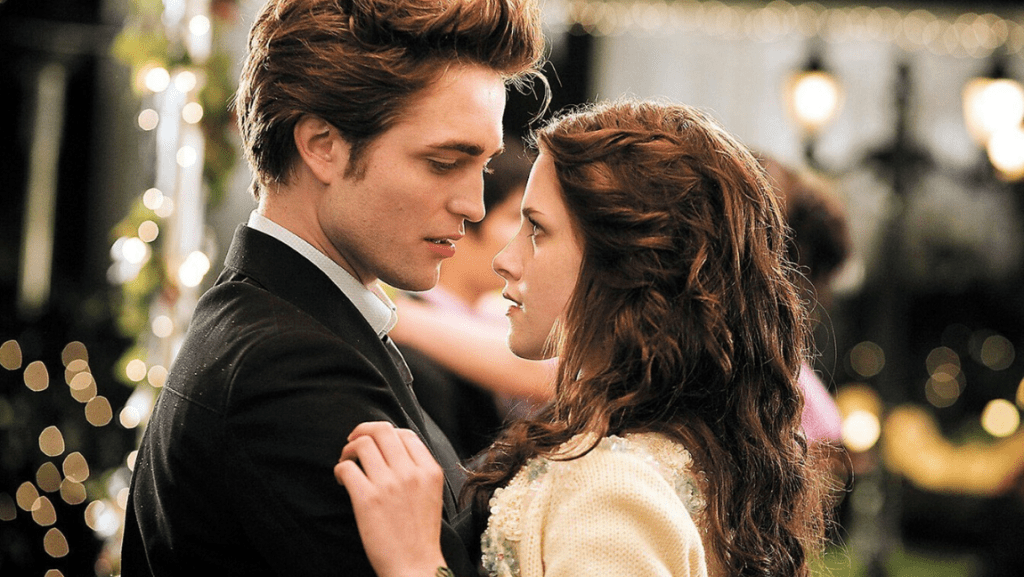
Edward Cullen is an older man, guilty of grooming a young girl – Bella is seventeen when they meet – with obvious nefarious intentions. So, many would have us believe.
But, as anyone who takes the time to engage with a text to the extent that they actually put pen to paper (thus, I reveal my age!) knows, our reading of a text reveals as much about our own preoccupations as it does about the text itself – often more so. For our preoccupations can very easily obfuscate our understanding of the narrative.
Let us use, as an example, an article by one Wind Goodfriend, a self-proclaimed “psychologist at the movies”, posted on Psychology Today in 2011.
Ms Goodfriend’s article is titled: Relationship Violence in ‘Twilight’. This, despite the fact that there is absolutely no violence between Bella and Edward at any point in the four novels – if one is willing to accept that a wild night of passionate sex, resulting in the destruction of a rather fine bed, doesn’t count as violence. God help us all if it does! Granted Bella does wake up the next morning with fairly obvious bruises, but this says a lot about Ms Goodfriend’s sex life if she has never been in Bella’s position. The only way we can accept Ms Goodfriend’s title is if we, too, see violence in a relationship without actually seeing it. It’s not there! It doesn’t exist! There just isn’t any!
For Ms Goodfriend to claim that Bella and Edward’s relationship is violent, she has to see it in the interpretation she applies to the text. This is where she reveals her own preoccupations. If there is no actual violence depicted, she must see it in what is. She must see it because she interprets it into the text. In other words, the violence she sees between Bella and Edward exists because Ms Goodfriend sees it. Not because it is actually there!
But, Ms Goodfriend is perfectly confident in stating that which she can’t possibly know! She claims that the popularity of the novels shows “just how much attention girls are giving to the examples of lovers displayed in Edward and Bella’s world”. I mean, it couldn’t possibly be that girls are fascinated by sparkly vampires or, God forbid, every young person dreams – male or female – to be found attractive by someone who we’d never expect to find us attractive! And don’t tell me that we all don’t feel this – males and females. When that beautiful girl that everybody expects to go with the captain of the football team actually chooses the guy with the glasses and the books? Damn! That guy feels exactly like Bella. And privilege, honour and humility are all part of that feeling. That Ms Goodfriend doesn’t seem to understand Bella’s feelings when Edward finds her attractive makes one wonder just what her psychology does for her analysands.
To these girls, Edward is “the troubled soul who is waiting to be tamed by just the right woman”. Well, firstly, what is so wrong with that? But, secondly, how on earth does Ms Goodfriend know what millions of girls around the world are thinking? Is she admitting that there is a female essence; that, because they are female, they must be feeling, thinking, and longing for the same thing? And this despite the fact that Edward makes it perfectly clear that he isn’t waiting for anything! His initial reaction to Bella is based entirely on his surprise that she is not as other girls are. To him, Bella is unique! It may well be that Ms Goodfriend only deals with females and therefore has little understanding of male psychology – upon this I speculate. But I do so because if she possessed even the most basic understanding of male psychology, she would recognise that, while males might be willing to sow their oats wherever the wind bloweth, to find that one woman who transcends all their expectations is always a fascination. One doesn’t need to be a vampire deprived of the ability to read the mind of a mere mortal to find a woman special.
Whenever we look at the relationship of others and find reason to criticise, we have to ask ourselves whether we do so out of jealousy for what we have never experienced.
The obvious problem with seeing Edward as a “troubled soul” is the simple fact that he doesn’t believe he has a soul. This is why he’s ‘troubled’. This is also his motivation in all that he does with Bella. To make him out as an archetypal predator of young girls, grooming them for sex, is to completely miss the fact that he is a person who seeks to do the right thing, believing all the time that he is doomed, yet, unbelievably, finding a path to redemption through love.
The other obvious problem with Ms Goodfriend’s interpretation of Edward as a ‘troubled soul waiting to be tamed by just the right woman” is the simple fact that she believes that it is girls who are paying attention. Is Bella a girl? Or is she a woman? At what point does a girl become a woman? Legalistically, we can put an age on it; you are a woman at the age of 18, for instance. But, again, as a psychologist, Ms Goodfriend should be aware that maturity has nothing to do with legality – Bella, along with all girls (and boys), is a woman when she’s a woman (or man).
Ms Goodfriend does give reasons for her belief in this relationship being violent.
First, she points out that Bella fits the characteristics of the abused.
Bella has low self-esteem, she is attracted to men who are forbidden and she is attracted to violence, aggression and danger.
To take these in order: to be aware that one is “uncoordinated, unsocial and unattractive” could be seen as a mature acceptance of reality. Bella is clumsy, she does slip on the ice and hit people around the head with badminton racquets. This is not low self-esteem; this is reality! What would be served by Bella deluding herself into believing that she is the most coordinated person in the school? Contrarily, she might see herself as unsocial, yet she not only makes friends instantly but she interacts with them precisely how one would expect an introvert to interact with a crowd of friends. I presume that Ms Goodfriend is aware of the difference between an introvert and an extrovert, even though she makes no acknowledgement of these basic personality traits. Finally, Bella perceives herself as unattractive. Well, geez, why would a girl who is untanned, living in a state like Arizona, feel attractive? It’s not like this isn’t made obvious in the novel. An introvert, who sits inside, avoiding the sun, in Arizona, and has never had a relationship before Edward Cullen – the most gorgeous boy in school – is bound to feel unworthy! If this is unhealthy then being normal is unhealthy because why the Hell wouldn’t Bella feel unworthy?
As for men who are forbidden, well, as far as Bella is concerned, Edward is not a man – if being seventeen is not considered a ‘man’. But this is problematical because, while Edward is actually 100 years old, he appears to be a seventeen year old. And, lest we quibble, he tells Bells how old he is. You can just imagine the pedophile, on the internet, inviting the young girl into his clutches, succeeding in his intentions after admitting he is a hundred years old, can’t you? I mean, where exactly does Edward come across as a pedophile? One can only feel sorry for Ms Goodfriend’s experience of men.
That said, what exactly makes Edward ‘forbidden’? The fact that he has never shown interest in any other girl doesn’t make him forbidden. It might explain their jealousy and, maybe, Ms Goodfriend’s misunderstanding of a gentleman. She demonstrates so little understanding of the male, how can we expect her to have any understanding of a male who comes from a time before the modern age in which men are vilified?
And, then, we come to Bella’s attraction to violence, aggression and danger.
I can only question whether Ms Goodfriend paid attention when she read the novel? Her title, let me remind you, is the violence in ‘Twilight’, which is the title of the first novel. This is a novel that I have read at least three times and I cannot, for the life of me, find any evidence of Bella being fixated on violence, aggression or danger. Just where, in the novel, is it? This is a girl who fell immediately in love with a 1953 Chevrolet pick-up truck precisely because it was safe. She only imagines ramming Edward’s Volvo, which is not a car to mess with, because her truck would sustain no damage and herself no injury. Bella seeks danger in the second novel, New Moon, only after Edward has left – in his mind, to keep her safe. In all the novels, when Bella is with Edward, she shows no particular desire for violence, aggression or danger. Ms Goodfriend is simply wrong in this reading of Bella.
Bella just doesn’t have low self-esteem. This is the girl who demands from the ‘boy’, who stopped a truck with his hand, to tell her the truth. This is the girl who, upon realising exactly what Edward is, confronts him and tells him what she believes. Without fear! Low self-esteem? This girl? I really don’t think so!
Shy? Maybe. Introverted? Definitely. Low self-esteem? Absolutely not!
All the way through the novel, Bella demonstrates that she is extremely aware of herself. She knows precisely who she is. And when she finds a way to become more, she jumps at the opportunity. She gets just as much out of Edward as he gets out of her. This is a relationship based on mutual respect and need for what the other has to offer. Why else enter into a relationship?
Ms Goodfriend then turns her attention to Edward and straightaway makes the point that he “attempts to isolate her from others”. Really? Has Ms Goodfriend actually read the novels? At what point does Edward make any deliberate attempt to isolate Bella? Quite the contrary! Why exactly does he insist on taking her – the girl who can’t dance and avoids dancing at all costs – to the prom? Why does this predator, who could so easily take this girl anytime he wishes, agree to go to such lengths to keep her family safe and, then, remain a part of her life, even after she becomes a vampire? Ms Goodfriend’s analysis of the novel is so wide of the mark one hopes she’s better at reading real people than she reads novels!
Ms Goodfriend also fudges the issue between Bella and Jacob. She claims that Edward forbids Bella to see Jacob. Even if he does, at what point does Bella take any notice of his injunction? This girl of low self-esteem does exactly what she wants whenever she feels the need. She never takes any notice of any injunction that might prevent her from seeing any one she wants to see. When Edward wants to whisk her away immediately when she is threatened by James, it is Bella who formulates the plan to go home and ensure that her father is safe. Ms Goodfriend’s reading of Bella is just wrong from beginning to end.
And it’s not like only men impose injunctions upon their women. What woman has never made clear that she doesn’t want her man associating with that woman?
I could go on through every point Ms Goodfriend makes in her article. But, really, what would be the point? She has so misunderstood the relationship between Bella and Edward – in fact, she has not just misunderstood the relationship, she demonstrates that she has little understanding of basic human emotions and the force of attraction between two individuals, there is little point in going on.
The simple fact of the matter is that this relationship is not what is expected of modern young people, especially in a world that sees men as the enemy. And Ms Goodfriend clearly sees men as the enemy, an evil force that is out to subvert, seduce and defile the innocence of girls. As if girls don’t have the self-awareness to decide what they want for themselves.
This is, ultimately, the purpose of Ms Goodfriend’s article. She presents it as if she only has the welfare of girls in mind. But this is not really the case. She wants to influence the minds of girls every bit as much as she accuses the novel of doing. The question for girls is whether they want to see men as predators – as Ms Goodfriend clearly does – or whether they are willing to accept that love is something that can actually happen between two people (whether they are male and female, as they are in this novel, is irrelevant).
This is not a novel about a girl who invites violence into her life. This is a novel that reminds us that, despite who and what we are, there is always the hope of love.
 Mark with an X
Leave a comment