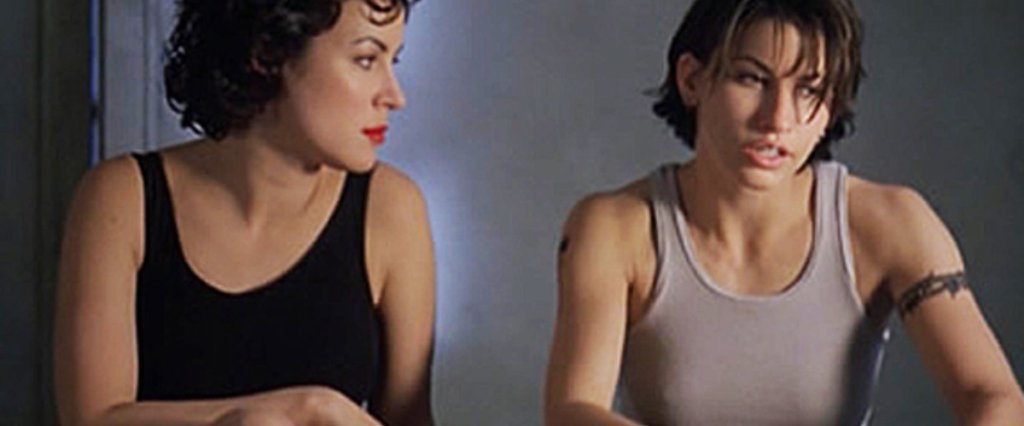
The biggest joke at the heart of the Wachowski Brothers’ (sisters?) ‘Bound’ (1996) is the mob’s laundryman not knowing where the laundry detergent is when he literally needs to launder the money. Violet may be the trophy all the mobsters desire, but she is practical enough to get done what needs doing. And, with no sign of a house maid, she sure knows how to keep a lovely home!
Violet is so practical, in fact, she is aware of her own weaknesses and is honest about them. Having encountered Corky purely by accident, she manoeuvres to get better acquainted with this woman she instinctively recognises as being able to accomplish those parts of the plan she herself cannot. Initially, she does this exactly as she would manipulate the men of her world – she gets Corky’s interest through sex. It is a currency in which Violet is rich beyond measure and she spends it to her own advantage.
Violet is perfectly aware that she is where she is because of the choices she made. We don’t know the circumstances of those choices, we only know that Violet has reached a point in her life where she is ready to make other choices. It is time for Violet to become the writer of her own text. However, unlike Vivian in ‘Desert Hearts’, Violet freely chooses an accomplice.
Knowing what she’s good at has kept her in comfort for the last five years with Caesar. Oh, so coincidentally though, five years is also the time Corky spent in prison. The Wachowski’s tell a good story very stylishly but subtlety is not a part of their repertoire. Those five years bind the two women through common experience. This is a film about choosing the ties that bind as much as it is about getting free from that to which one is bound.
By working together, Violet and Corky break the bonds that held them captive and forge new bonds to each other. If anything, this film is the reverse of ‘Desert Hearts‘. Where that film has the two women enter into a passionate relationship and then realise that it will take hard-headed decisions to keep it going, Violet and Corky begin with the hard choices and develop the passion as they move forward.
Lacking subtlety, the Wachowski’s lay everything in the open: there’s lots of talk about trust and, of course, that visual gag mentioned earlier. Because this is a film about a lesbian couple, there is lots of hand imagery: ten questions, snip, snip – and Corky washing her brushes. Not to be too prurient, but my favourite is the lesbian bar called The Watering Hole! Geddit? Of course you do!
The film works because it is a damn good story well told, with such style and confidence one cannot but be smitten. And there is tension. I don’t think there’s ever any doubt that the two women will outsmart the gangsters whose $2,000,000 they plan to steal. No, the real tension is whether Violet, who probably inspired Shelley to skim the cash in the first place, will double-cross Corky. In the film noirs of the Forties, to which due homage is paid, this is a likely outcome. Because we are aware of the film’s antecedents, we are waiting for Violet’s duplicity, so we’re not as surprised or disappointed as Corky when she sees and then hears Shelley’s entry.
One cannot but hope this relationship will work because it is so obviously the right thing for both women.
Corky’s five years in jail were due, apart from her breaking the law, to a partner who proved untrustworthy. She is burned and jaded and satisfied with pickups in bars. Violet is dangerous, not only because of what she proposes but also because she is so obviously a woman one could fall deeply for. As far as the plot is concerned, she uses this to her advantage; as she says to Corky, “Do you think you’re the only one who was good at something?”.
When she agrees to Violet’s plan, Corky has no real reason for doing so except her need to try one last time at trusting someone. In a quite literal way, if Violet let’s her down, Corky will not survive. Whether gunned down or not, Corky would be dead. $2,000,000 is a nice incentive but it is never really Corky’s motive. It is, however, just one more reason for not rushing into Violet’s scheme. Shelley is a prime example of what happens to those who trust Violet.
I often write about how it is important that each individual should be their own authors, that we should not be content with the texts that others would have us live. Deacon Frost, in ‘Blade’ (1998), is as good an example as any of what it looks like to be an authored text with no freedom to inscribe one’s own textuality. He is a monster!
When I wrote about Donna Deitch’s ‘Desert Hearts’, I identified Vivian, despite her name, as a person desiring to leave her old life behind without being able to see in which direction she should go instead. Consequently, she is cornered by a predatory seducer of the same sex and, having no clear ideas of her own at a time when she’s vulnerable, she ends her story begging the other to follow.
Corky is never going to beg anyone for anything. Her trust in Violet will work out or it won’t; it is her last roll of the dice. Unlike Vivian, Corky enters into a relationship with Violet fully aware of how badly it could all turn out but willing to take the risk because she chooses as integral to her text an other with whom life should be lived. Her text, if she is to write it as it should be written, must include this other. She is willing to bet her life on it.
Although it is Corky who talks about trust, it is Violet who really needs to learn what this means. Corky may have experienced the consequences of trust gone wrong; Violet has never trusted anyone.
Violet uses people, or, more specifically, she uses men – because they use her. She is just better at the game than the men – Caesar or Mickey – give her credit for. They are Mafiosi, with Victorian ideas of a woman’s role. Violet is much more than they can ever imagine, which is why Caesar is placated when he discovers it is another woman with ‘his’ Violet, and why Mickey could never imagine her as culpable in the disappearance of either Caesar or the $2,000,000.
What Corky is risking for a last throw of the dice, Violet is risking for the very first time. ‘Bound’ is such a satisfying film because it reaffirms our faith in humanity, that it is possible to find that one person with whom it is possible to share trust. Having pointed out their differences earlier, the film ends with Corky’s recognition that there are no differences between them.
Of course there is, but none that matter.
 Mark with an X
Leave a comment