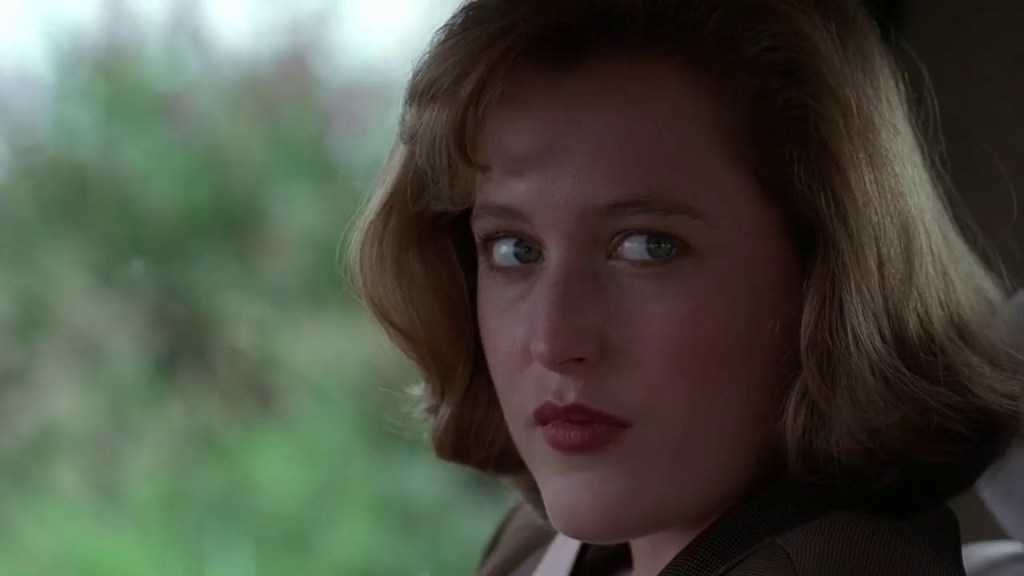
The m0vie blog tells us that we get a “ham-fisted attempt at moral debate” in the first episode of the X Files after the Pilot. One might ask what other kind of moral debate one could expect from a country as morally bankrupt as the United States? The US is a country in which its people are gunned down in the streets, in the churches and schools and yet its government does nothing to prevent this from happening. What other nation’s government would get away with such blatant disregard for the safety of its people? Yet this same government points its finger at other regimes and condemns them as axes of evil. Is it any wonder that Americans are prone to fantasies of conspiracy when there is little hope the government will do what the constitution swears them to do – simply serve the people?
The m0vie blog tells us over and over again that the X Files captured the zeitgeist of the 90s, implying, one supposes, that its message is not quite as relevant today as it once was. The title of this episode does seem to support this view that the show is concerned with a time long past, with concerns no longer immediate.
This best of all X Files review sites is right about one thing. The level of paranoia is not what it once was. Not because the United States government has learned the errors of its ways and now devotes itself to the well-being of its electorate, but because the people themselves no longer care. Not only is there to be no second Watergate, the POTUS who betrayed his people is likely to win a second term in office. How the spirit of Richard Nixon must be wishing he’d been born at a different time!
That ham-fisted moral debate from Deep Throat concludes with Scully’s declaration, “Look, these are questions we have no business asking”. It seems Chris Carter, who “demonstrates that he was never the strongest writer on the show’s staff”, and who was prone to writing dialogue that “feels a little clunky”, might be, for all that, not only perceptive but prescient. Who else, in the 90s, foresaw a time when Americans would get tired of asking the questions that could bring down a government?
It is, however, an interesting point – does a government ever have the right to such secrecy that the people should simply accept what they are told and thus confer on their elected officials the power to conduct all kinds of shenanigans in the name of national security? There are advantages to such a position – the Stealth Bomber being a case in point, as it is mentioned in this episode. Does the human cost ever become too high?
The simple answer to that question, as far as the United Stages government is concerned, is clearly No! Successive administrations beat their breasts and send out their prayers and do precisely nothing to prevent innocents being gunned down on an all-too regular basis. And now we have a POTUS who publicly lauds the very regime that for so long was the very impetus for secrecy!
The m0vie blog condemns Carter’s dialogue because “[t]hat’s not the way that people talk to one another”. You mean people used to talk to one another? This is obviously a time before those clunky phones the agents carry grew smart.
Clearly there is a link here – when people used to talk to one another they asked questions that could bring down governments; now we’re so busy trolling we’re too distracted to notice what government is doing, so caught up in expressing our vulgar thoughts on who is wearing who on the red carpet we have no time to consider who might be betraying who in the White House.
The dialogue between Scully and Mulder may well be clunky, but it shows that, even after Watergate – an event that so influenced Chris Carter’s perception of the world – there remained a naïveté that could still find reasons to trust the government and the need for secrecy. But this was indisputable at a time when the vast mass of the Soviet Union was arrayed against the West. Chronologically, the X Files came along after the dissolution of the Soviet Union, experientially the time difference is negligible.
Also, it is well within Scully’s character to express this sentiment. A scientist, Scully lives by the belief that the physical world is explicable, even if we don’t have the explanation just yet. This is the nature of science, that oh, so rational of enterprise! “We don’t have all the answers yet, but we believe we will one day. And when we do, however long it takes, we’ll be able to prove that the answers you believe you do have are wrong!” What could be more rational?
In other words, it is just as much in the spirit of science to put its trust in what cannot be proven as it is the spirit of any other form of belief. Even if that belief is in a government, which may not be tangible, but is, at least, a phenomenon and therefore accountable to our ideals. Scully, a mere eight years old at the time of Watergate, is conscious of a need for political scepticism without fully grasping the immediate reality. So unable to believe Mulder’s extreme possibilities, she holds out hope that the world more closely resembles her expectations and scientific rationality. Her journey on the X Files will teach her that, while her science holds in principle, human beings, on the other hand, are just as clunky as Carter’s dialogue – not because they don’t talk in that way, but because they don’t share the same concerns that drive Mulder. Despite his need to hold the evidence of the existence of extraterrestrials in his hand, he also seeks to show his fellow Americans that their government is acting against the best interest of the nation.
Has that much changed since the 1990s?
 Mark with an X
Leave a comment