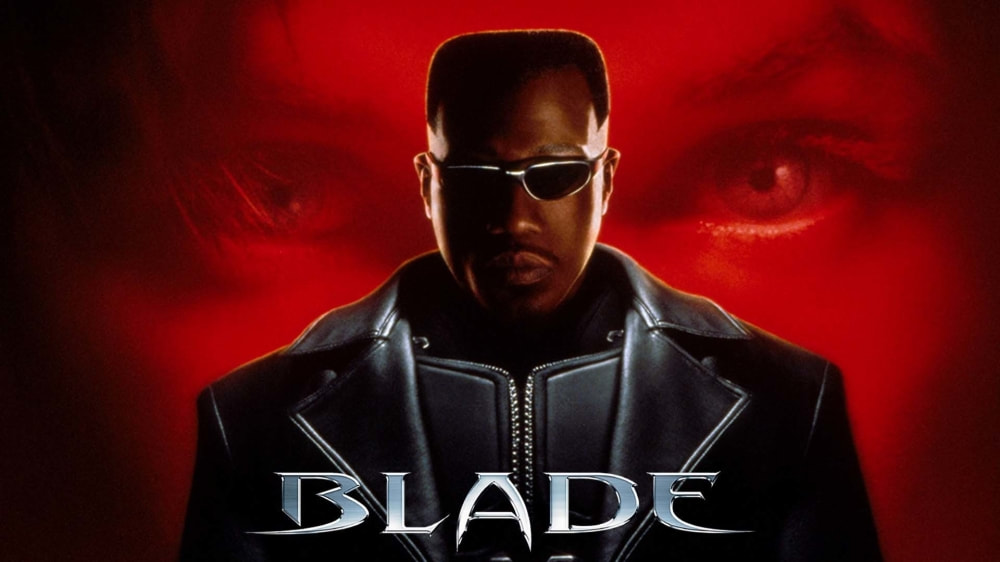
The character Blade is a half-human, half-vampire warrior of the light. A Marvel comics creation, Blade will soon make an appearance in the MCU. Blade has been fighting vampires since he appeared as a supporting character in 1973’s ‘The Tomb of Dracula’ #10.
But, let’s think about Blade for a moment.
Half-human, half-vampire? Well, okay, as long as our disbelief is suspended, I suppose we can accept that a pregnant woman bitten by a vampire might produce something other than a merely human baby. If smoking and drinking can affect the foetus then it seems reasonable to assume the introduction of vampire blood into the mother’s system might do so also. Just what these effects would be would surely be unpredictable. That Blade was born with “all their strengths, none of their weaknesses” is highly improbable – certainly fortuitous.
But Blade, despite the obvious tragedy of losing his mother, is one lucky pup. Except for the thirst – because, of course, there must be some flaw in our heroes – he was found by just precisely that one guy who possessed the know-how to, first, recognise who (or what?) he was; second, develop the serum that would keep the thirst in check; third, possessed of the right balance of tough-love to train him up as the perfect antidote to evil. Why can’t we all be so lucky?
If Blade himself demands a stretching of imaginations those against whom he is opposed beggar belief.
Purebloods?
Yeah, I know I’m suspending disbelief – but do I have to throw basic logic out with the bath water?
What, in any given universe, is a “Pureblood” vampire?
First of all, apart from their being dead, if they had blood of their own they wouldn’t need to feed off the blood of others. The beating heart of the living pumps the blood. No beating heart, no blood flow. Hence the need for living blood.
Second, being dead is detrimental to one’s sperm count. Not to mention the sheer illogicality of life growing within a dead environment. There is a reason why nature abhors a vacuum. Dead things don’t have babies. Would kind of spoil the purpose of being dead, don’t you think?
So, what exactly is a “pureblood”? Does my willingness to suspend disbelief somehow confer on the film maker the right to film his mushroom dreams?
What Hollywood and bad novelists (like Dan Brown) never appear to understand is the simple fact that, however imaginative, a story has to at least pay lip service to logic. If you want “purebloods” in your script, give ‘em some origin. If Blade deserves an ‘origin’ story (yawn!), don’t those he has dedicated his life to fighting against at least need to make sense? If a man fights that which is senseless it is probably because he too is lacking a sandwich or two at the picnic.
Even if one resorts to the myths – Judas Iscariot or, God forbid, Vlad Tepes (and quite why the West is so willing to demonise a national hero is questionable) – the logic doesn’t work. Judas, for instance, became a vampire after he hung himself. But before the drop, he was human. Is there really that much difference between being invaded by a demon after death and becoming a demon after death? Even my hair isn’t that fine!
If Judas was the first, where did the second come from? It’s the same conundrum faced by those who take the Bible literally. If God created only two human beings, Adam and Eve, how did the species go forth and multiply? Of course, Adam and Eve had two sons, Cain and Abel, but then…? Just who did these two young-bloods procreate with? Same with Judas as first vampire; who did he turn to in order to propagate the species? This question is irrelevant, however, because Judas most definitely wasn’t a pureblood vampire anyway – having once been human. Whatever the circumstances of his vampiric pre-eminence, he was/must have been ‘turned’. Hence, he could not be a pureblood, not having been born a vampire.
Whichever way you look at it, the pureblood vampire is a figment of some fervid desire for the very status one wishes to overthrow. Which is where Deacon Frost comes into the story. In a wee while, anyway.
So why bother with ‘purebloods’? What is their purpose?
You got to think on the timing of their appearance. Just when the vampire was being humanised (What is Blade but a humanised vampire?), the pureblood pops up fully formed. Ex nihilo.
If we’re going to have vampire heroes and lovers then we need a vampire who isn’t too much different to ourselves. Yes, they always retain an element of danger, but it’s a danger that operates in a world of checks and balances. For let us not neglect the fact that the humanised vampire is an American creation. We Europeans can take our evil a little neater than our New World off-spring! If the good guy can’t wear a white hat, at least it can be grey. Just think of every single Hollywood remake of a European movie (my pet peeve being Matt Reeves‘ ‘Let Me In‘, a horrible remake of Tomas Alfredson‘s superb ‘Let the Right One In‘). Probably, it has something to do with the country being so big. Transylvania is so tiny, in comparison. Evil thrives in small places. When you have a market as large as the US, well, then, you have the cartoonish blowing up of the evil bad guy that we get at the end of ‘Blade’ (1998).
The European vampire was a loner. While Dracula may have had his ‘brides’, they certainly weren’t for company’s sake. The only time we see Dracula and the brides together is in Chapter 3 of Stoker’s novel, when they are about to devour Jonathan Harker. With exquisite timing, Dracula appears, thus saving Harker, and leaves the three female vampires a “half-smothered child” upon which to slake their thirst. There is no mention of the three brides travelling with their master when he transposes himself to England. Indeed, Harker informs the reader that he is left “alone in the castle with those awful women”, after the Count’s departure.
It is certainly meant to be a part of Dracula’s horror that he is so unfettered by the norms of society which would normally dictate a man’s connection to family and friends. The heroes of the book, Van Helsing, Dr Seward, the Hon. Arthur Holmwood, Quincey Morris, and Harker, dedicate themselves to the vampire’s destruction specifically in order to save Mina, Jonathan’s wife. This is the role of a man, at least in the Nineteenth Century. Not only is Dracula the threat from which they must protect the helpless female, by having no such allegiances of his own, he threatens the very fabric of the society which defines their roles. Ironically, then, that this is probably the very element of his character which most appeals to the new wave of vampire wannabees.
Deacon Frost is identified as continuing this adversarial role. But, because there is a less-oppressive hierarchy in Western societies in the late-Twentieth/early-Twenty-first centuries, his rebellion must be directed against Dragonetti and those born vampires who sit at the head of the House of Erebus. The purebloods, then, serve as substitutes for, or mirror images of, those ideaologies that once stood as “controller and judicator of subject positions”, as Simon Bacon would say in his book ‘Becoming Vampire‘.
This, then, answers our earlier question concerning the purpose of “Purebloods”. They are, while never quite making sense, a necessity if the vampire is to retain its transgressive nature. Just as youth protest has shifted from society at large to focus more on corporations, so the vampire – in the case of ‘Blade‘ that’d be Deacon Frost, et al – is no longer seen so much as a threat to the very fabric of (human) society – though humans retain their status as the primary source of food – so much as a rebel against the corporations, or houses, of the vampire world.
Which, unfortunately, poses another question.
If it’s cool to rage against the old order, why does Deacon Frost spend pretty much the whole movie translating ancient scrolls, if not to establish himself as a new old order?
Isn’t this really the nature of all rebellion? Not to establish something truly new, for those who waste their time rebelling against what is are just as bound by the constraints they claim to resist. Being so limited, they really have little choice but to remake that which they destroyed, and thus revitalise the controllers and judicators in however different a guise.
 Mark with an X
Leave a comment